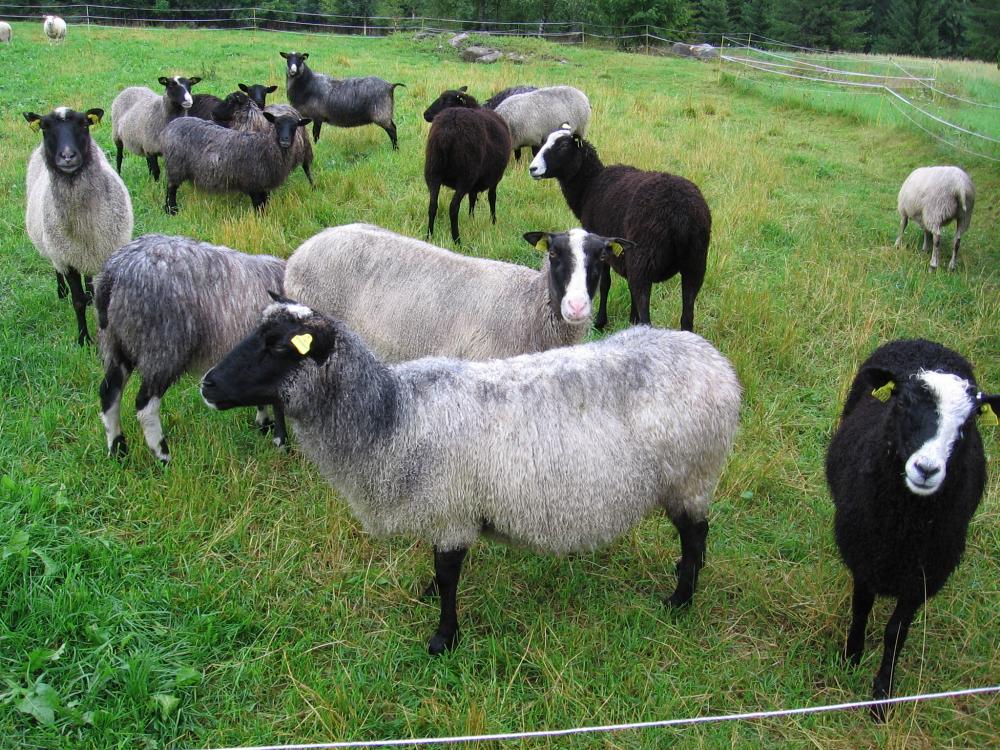
Kainuu Grey. Photo used with permission from Aholan Lammastila
Kainuu Grey, Kainuun harmas in Finnish, is one of the very sparse Finnish sheep breeds. It was considered to be a variety of Finnsheep until quite recently, but is now a recognized breed. It’s originally a dual purpose sheep that produced pelt for clothing, and meat. Nowadays it’s mostly a wool and meat sheep, as furs are not used to the same extension as before. The lambs are born black, and turn into various shades of grey when they grow older. The legs are black. I think the breed will develop into a more defined wool producer over time, as clothes made from sheep fur are seldom used any more. Some of the Kainuu Grey fleece’s I’ve spun have the tight curls that are wanted in fur sheep, whereas some are clearly more like the wools we want in spun yarns.
But as with most breeds nowadays, meat is the main product. How that will effect the breed is difficult for me to say. Many of the farmers that breed Kainuu Grey want to preserve the breed, which means bringing in big meat breads in the breeding program is not an option. A spinning friend in Wales said that moving a breed from lands with meager food to a region with better feedstuff will make the animals bigger and they produce bigger carcases, which of course sounds very plausible. The landscape in Kainuu is pretty well suited for livestock, but too far north for growing grains. In Scandinavia cattle was traditionally kept on better grounds, sheep could take what was left. Nowadays most of the sheep farms are farther south, and they are often on good lands. All sheep breeds in Finland have become bigger during the last 100 years. My guess is that over time Kainuu Grey with soft, Finnsheep-like wool will be used in breeding rather than the fur types. Right now the farmers mostly try to make the breed survive. There were not so many left when Kainuu Grey was saved at the last moment.
The first time I came in contact with Kainuu Grey it was in the form of a skin. I fell in love with the beauty of it: silvery grey at the sides with darker, tight curls at the back. It felt lovely, my hands loved it also! At that time I had no thoughts of spinning Kainuu Grey. Later, when I heard yarn was being made from the wool, I thought it wouldn’t be very nice, that it would be prickly. But something has happened, and I believe it’s a result of the furs not being used, and because all animals that are of any value for the breed have to be kept alive and in the breeding program so they are not slaughtered if not necessary. The Kainuu Grey I now come in contact with is often soft and nice, a joy to work with for a spinner who likes short wools.
Dark grey Kainuu Grey
I bought the fleeces from Aholan lammastila, one of the few that breed this sheep. It was good wool, no VM, but it was very dirty (it had been a rainy autumn). I had dark and light grey fleece, that I combed and rolled into faux rolags.
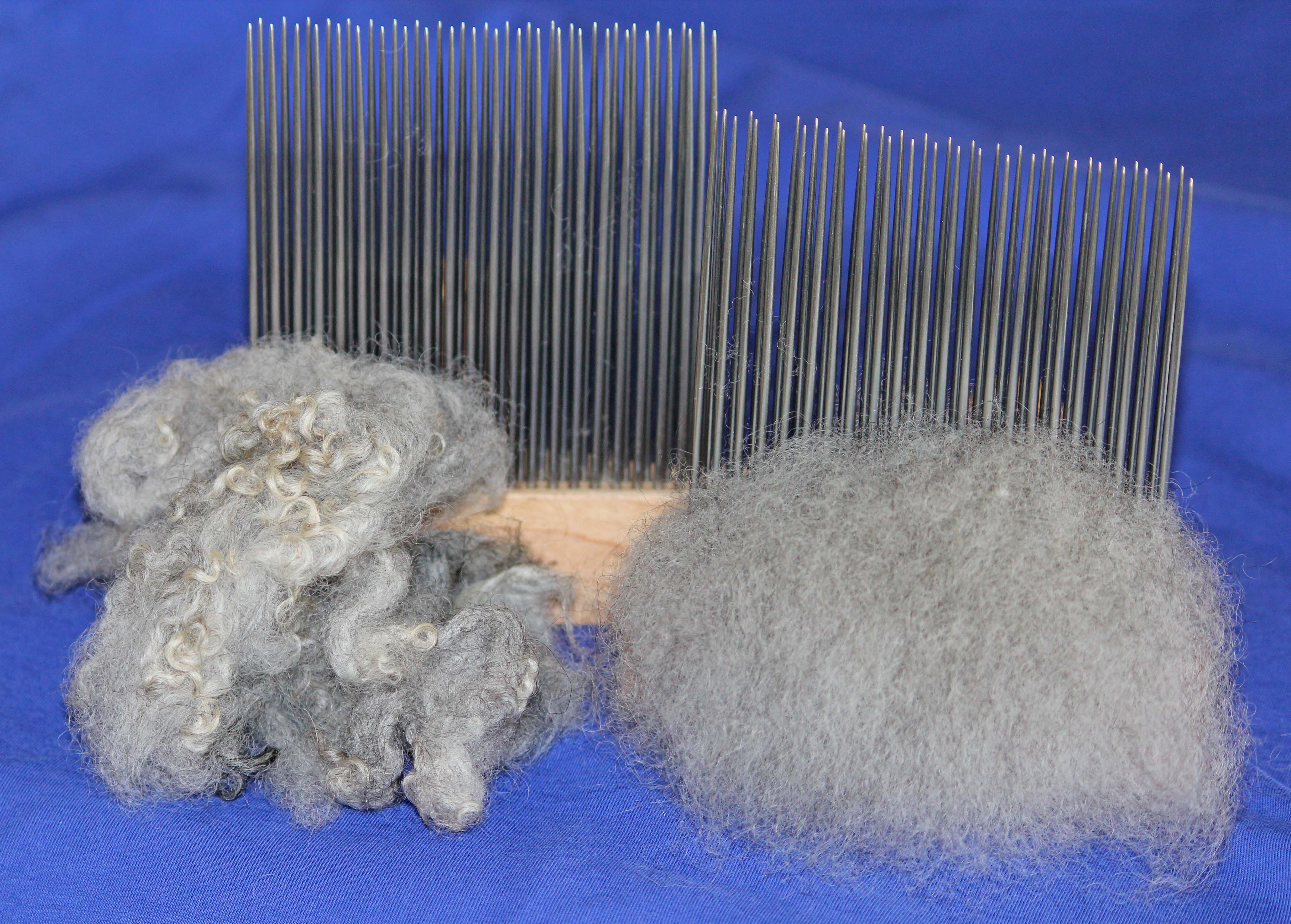
Wool combs: Valkyrie fine
Louet extra fine carders
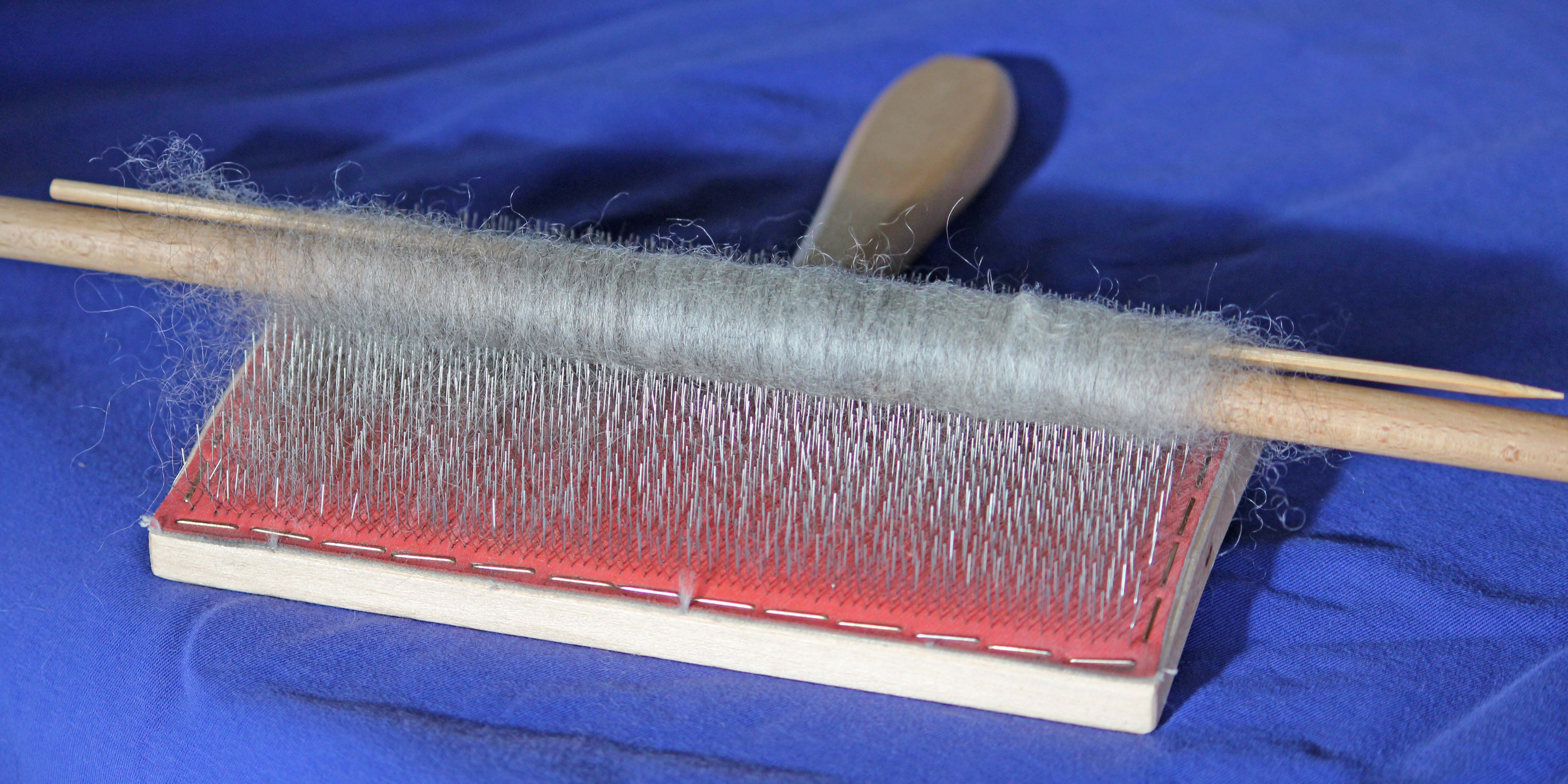
Faux rolags
Now why on earth did I do that? The wool is short, and could easily have been carded into real rolags for soft woolen yarns. Because I almost destroyed the fleece when scouring! It felted, and carding was a pest. For several months I attempted thorough teasing by hand, flickring, beating, but nothing made me happy. So one day I took my Valkyrie combs designed for short, fine wool and made a test: it worked! I lost pretty much valuable fleece in the combing process, but on the other hand I saved some for really nice semi-woollen yarns.
The rolags drafted like a dream. Spinning woolen was was a joy, so I chose a long against twist / double draw. I’m quite happy with the result.
Kainuu Grey. 2- and 3-ply, light and dark grey
Light grey:
90 grams, 214 meters: 2-ply
160 grams, 470 meters: 3-ply
Dark grey:
130 grams, 360 meters: 3-ply
40 grams, 117 meters: 2-ply
Kainuu Grey is suitable for everything. Sweaters, hats, mittens, knitted and woven scarves and shawls, and socks if you blend with silk for strength, and woven cloth. When combed and spun worsted it makes a very strong yarn. The darker shades can be a bit prickly, which is typical to natural colored wools. The black lamb’s wool is soft and not suitable for socks, but makes lovely yarn for hats and scarves.
When browsing today I found two shops on Etsy where you can buy Kainuu Grey: Woolgrey and Mielitty, but there may occasionally be a few more. As it’s a rare breed and almost unknown everywhere else except in Finland, it’s not easy to find fleece and yarns if you don’t speak Finnish. There are a few farmers that sell fleece and yarns: Villa Laurila, Herrakunnan Lammas, Noittaan Tila, and Aholan Lammastila (link above). The wool and yarns take dyes beautifully. If you’re looking for fleece you should do it the next few weeks, as they usually sell out pretty fast after the autumn shearing.
When working with my Estonian Native Sheep wool samples I got interested in how salt affects wool. I also wanted to know if soaking wool in sea water has been common in Scandinavia and the Baltic countries. I turned to the spinners on Ravelry and Facebook. Spinners from Scandinavia, the Netherlands, UK, and US responded at once!
On Ravelry I wrote: “I got a few samples of Native Estonian Sheep (Eesti maalammas) wool. It’s been scoured in the traditional way in many coastal areas around the Baltic Sea and the Gulf of Finland, by soaking it in the sea. The wool feels quite different from other wools I’ve worked with, dry at first and when I tease and card it I can feel the lanolin. Some of the samples are very fragile, which can be a result of long storing, but I wonder if it can also be a result of the salt in the water. The Baltic Sea and the Gulf of Finland have brackish water.“ I asked: “Do you know what sea water does to the wool except cleaning it to some extent? What happens to it?” The discussion was held in English.
On Facebook I asked: “Do you know what sea water does to wool, that is, how does salty (brackish) sea water affect wool that is scoured in the sea?” I also asked: “How common has it been to wash wool in the sea or in sea water on our coasts?” By “costs” I meant Scandinavia, as the members in the group in question are primarily from Sweden, Norway and Denmark. The discussion was held in Swedish and Norwegian.
I also had some answers from British members in Online Guild of Weavers, Spinners and Dyers. They tell about sailors in the Royal Navy and the merchant fleet washing their clothes in sea water all over the world in the first half of the 20th century. One person has heard that wool was washed in sea water in Faeroe in the old days. Another tells about a bay called “Sheep Wash” in Wales, where the farmers did just that: washed sheep.
Below is a summary of the discussions on Ravelry and Facebook as by Friday, 18 October 2013 at 5 pm Finnish time. Both communities are closed, so I will not tell who said what. Quotes from Ravelry are surrounded by quotation marks. There are no quotes from Facebook, as that discussion is interpreted in English by me. If I have misunderstood or interpreted in a wrong way, please contact me or comment in this blog’s Comments, and we’ll get it right. I have asked the participants in both discussions for permission to publish this summary. I have checked with Ravelry that it doesn’t violate Ravelry rules. I haven’t found anything on Facebook that forbids it either.
Now then. An attempt to make categories will perhaps make this easier. I did not cut posts that discuss more than one aspect of wool and salt.
I have also added some information, mostly links, that where not included in the original discussions.
1. Customs and traditions
An informant from Norway says that mittens and socks have been washed in sea water, and that sea water is considered to be a gentle detergent. A Norwegian book about housework “Husmorboka” (several editions) says that salt is a cheap and gentle detergent for wool. It says that salt makes the woollies softer.
An informant from Sweden with roots in Estonia says that in the 1930s Estonian sheep were washed in a fresh water stream that had been dammed up.
A Swedish informant says that especially on the west coast of Sweden it was common to wash woollies in sea water or in fresh water with added salt. It was told that women who moved to the inland added salt to the laundry water and that people there laughed at them because they held it to be completely unnecessary.
An informant from the US says: “Many years ago this came up as a question on Fibernet (one of the first if not the very first fibre oriented mailing lists).
Variations of soaking the wool in the sea seem to have been practised in many places in Europe. For instance, in the Netherlands, supposedly sheep were driven through the sea about a week before they were sheared to make the shearing easier. They’d be soaked in seawater but by the time shearing came around, they would have dried off.
A chemist on the list (whose name I can almost but not quite remember) said that the interaction between the lanolin and various forms of salt in the water would produce soap, which would help lift some of the lanolin and dirt away from the fleece.
All soaps, so far as I know, are alkaline. Soaking too long in a soap solution will make wool feel rough at first and then become brittle.
My guess would be that with the wool you are processing, the staple formation protected the cores of the locks from being exposed to the brackish water, ending up with staples that are harsh and/or brittle around the outside with a core of greasy unaffected wool in the centre.”
An informant from the Netherlands says: “In my country the common practise always has been to pre soak a fleece for a day in water with added salt. Preferably rain water – so I was told years ago. This was done to get rid of dirt and sheep’s sweat. Not so much to remove lanoline, allthough some of it came out as well. Rinsing with clean water also was prescribed, for the salt should not stay in the dry wool – it would make wool brittle. I have cleaned my wool that way for many years, but then concluded that I really like to spin my wool without grease at all – and started to wash my raw wool with soap before spinning. (I do pre soak, but in clean water)
I think this discussion is very interesting – thank you!
I have found a restored sheep wash pond in my village. It has been there for a long time, since de middle ages – and almost had gone – luckily it now is restored and bears a sign where the phenomenon is explained to bypassers.”
This informant also linked to a video showing sheep being washed in the 1930s:
A post by Barbro with quotes from an e-mail: “I have an answer from the sheep farmer (her name is Kadri) in Estonia:
‘In Muhu sheep were washed in sea before shearing. I did it also when I still had only a few animals. Makes shearing much nicer. Nowadays we mostly only soak wool to get rid of the crap and juniper needles and wash it later in luke warm water so we can send most of it to the factory.
Some of it I spin myself for extra warm and water resistant stockings and then I only wash ready made stockings.
My grandma always made grandpas fishermans garment of the wool not too washed.
Actually about sea minerals – back in soviet times Saaremaa wool was known to be more soft than mainland wool because sheep grazed on seashore meadows with more minerals. I’m not sure these minerals work when applied outwardly, but when taken inside they are only a benefit for the wool :)’
She also says that the wool she sent me was winter wool, and thus not of the best quality, because that’s what she had when she got the request for samples. She says the sheep that provided the brittle samples had been badly attacked by horse flies, so the wool was damaged from start.”
A Swedish informant says that wool was probably washed in the water that was at hand.
Barbro told about her grandmother doing her laundry in sea water in periods when there wasn’t enough fresh water. This happened in the 50s in the Ostrobothnian countryside on the coast. They also had to use sea water as drinking water for the livestock, but this could only be done in short periods. The water is brackish. No knowledge of wool being washed in seawater, as my grandmother didn’t spin any longer in the 50s.
2. Sea water and wool
This part of the discussion deals with what happens when wool or clothes come in contact with sea water.
A spinner from the US (California) said: “Very interesting. I am going to have to try this just for fun and learn more about it. I don’t know if I want to use the sea (ocean) water where I am. I don’t like to swim in it because it is so foul. But clean sea water would be nice to try. I will get some next time I go up the coast and try a small batch.”
A spinner from the US (the east coast): “My experience of ocean water is that it’s corrosive. I expect short-term exposure has no effect if the item (whether fleece or sweater–or bathing suit, for that matter:-)) is well rinsed afterward, but I wouldn’t consider soaking anything in seawater.”
A spinner from the US gave advice on saving brittle wool: “Even if there isn’t any salt in the water to start with, sheep sweat a lot and produce plenty of their own salt. That’s the idea behind the fermented suint bath method of prepping fleece.
The brittle fleece is probably too far gone to remedy but for any fleece that feels rough to the touch, giving it a bath in water with a glug of vinegar may help in correcting the pH and removing the remnants of any soap that may still be in the fibre.”
Estonian Native Sheep. Two brittle samples
A spinner from the US gave a link to a handbook for shipping wool. There’s a paragraph that deals with damages from sea water: Cargo Handbook, Wool.
A Swedish informant says that his family bought 20-25 kilos of yarn from a shop that was to shut down. It was used for felting and some of it was also dyed with mushrooms. The yarn had been at the bottom of the Atlantic Ocean for several years. It was a bit harsh, but very durable.
Another Swedish informant said the Paracas textiles lay buried in the desert sand on the coast of Peru for 2000 years. The sand has high salinity, but it hadn’t effected the textiles. Now air and wrong pH destroy them.
An informant from the US (east coast, same person as above). “I’ve never deliberately washed anything in salt water.” In an earlier post she answered my question about how long the textiles that rotted had been in sea water: “No, not in the water. But if you hang salt-water-soaked clothes to dry as they are (i.e., without rinsing), the results are weakened fabric. Eventually you get easy tearing along any creases. And repeated or lengthy exposure has much the same effect on clothes as it has on car bodies.
Incidentally, I can’t imagine anyone getting out of the water and saying, “Oh, I just love what that swim did for my hair!”:-) I tended to head for a shampoo pretty promptly.
I’ve lived next to the Atlantic Ocean for most of my life, and for the first 30 years spent a fair amount of time immersed in it.:-) Any clothes not washed or well rinsed promptly afterward rotted.
I was surprised by the different views here so I googled “textiles recovered from the Titanic” and the sites I found spoke of the known corrosive effects of salt water; I was relieved to find I’m not crazy.:-)”
A person from the US said: “I wonder if the water melting off glaciers has an effect? We know it has a climatic effect in that the cold fresh water that comes off the glaciers each summer is heavier and denser than the water in the Gulf current, so that it sinks, then flows slowly southward. That sinking action draws the Gulf current north and keeps the British Isles and France (among other countries) warmer than they would otherwise be. A gardening example is that the south of France is at about the same latitude as the US state of Maine, which means they have the same amount of light at the same times of year but oh, what a difference in the plants that can be grown in the two places!
So what I wonder is if the seawater around Norway and Sweden is less salty than in other parts of the ocean and if that might have an effect on wool scoured in it.
Or perhaps the damaged fleece you have was already damaged while on the sheep for some reason and would have been useless for textiles no matter how it had been washed.
So many questions and so little grant money to answer them!”
The discussion about salinity in sea water continued for a while. This is part of one of Barbro’s posts on the matter: “The Atlantic is saltier than the brackish Baltic Sea, and during the summers lots of fresh water flood out from glaciers and rivers. It was probably during the late spring, summer and autumn they washed their wool and woolen clothes. Scandinavia including Finland has thousands of rivers flooding out into the Baltic Sea each year. I can sea rivers in the maps of the Baltic countries also, and Germany and Poland. It depends on in which part of the sea the shore is whether the water is polluted or not. There is also water from the Atlantic coming in all the time.” […]
A Norwegian informant brought up the question of woolen sails. He said the Vikings couldn’t have gone to all the places they did without the sails.
The sails were not discussed any further, as it seamed to take the discussion away from the question of wool being washed in sea water. I remembered that sails where impregnated with tar, which I today found to be true: found to be true. Hence sea water could not be the secret behind the efficiency of Viking sails. Here’s another article about Viking sails:
There was some discussion about North Ronaldsay sheep. The sheep get soaked in sea water when eating sea weed. They get rinsed in rain, over and over again. They or their wool don’t seem to suffer from it. By a funny coincidence I got a sample of North Ron from North Ronaldsay yesterday. I washed it today, and I think it smelled – salty. I probably hallucinated 🙂
North Ronaldsay fleece from North Ron. Like sea water
The discussion about why wool (and clothes from other materials) suffer from sea water in some parts of the world and not (at least not very badly) in other parts went on for a while. The conclusion of this seems to be the concentration of salt in the sea water, and also how long the wool has been in the water. The question isn’t by any means solved.
On Friday afternoon I had an e-mail from Annika Michelson, who’s employed in the KnowSheep project. She says that sheep in Estonia have been washed in both sea water and lake water. Today highly alkaline water that probably contains some sort of minerals from wells is used. The sheep drink the brackish sea water and eat sea weed, which probably is good for them. On the other hand it’s been noticed that sheep in a little Estonian island have black livers in the summer (iron, Fe), which indicates they eat something with iron in it. They’re not harmed by whatever it is that causes it. If they are slaughtered later in the autumn after having grazed on other lands their livers have returned to normal color. She says “There’s still so much to research!” she says.
ETA 19 October: Annika wants to correct a misunderstanding: Sheep eats / drink something that makes Fe to deposit in the liver”.
Yes, you saw that: sea weed. So the sheep on North Ronaldsay are not alone.
And just now, when I was about to publish, another mail from Annika about washing wool on another Estonian island, Hiiumaa: When the ground is frozen and the first snow has fallen in the autumn, they lay out raw wool on the snow on the north side where the sun won’t shine upon it. When more snow falls they shovel it on the wool so it’s completely covered. Later in the winter more snow falls and they don’t have to shovel any longer. When the snow melts in the spring the wool is clean! And it’s soft and nice in every way. The project has tested the method at Lahemaalammas (site only in Estonian but with lovely photos of sheep and products) and it works fine. Friendly to the environment, very little work, and the nature does it for free. No mice or voles. The wool was put in mesh bags of the kind used for onions.
3. Chemistry
I don’t feel capable of summarizing the chemistry discussion, so I copy everything, pairing questions and answers. I call the participants (1), (2), (3), (4) in the order they first appeared.
(1) opened the discussion on chemistry: “Hi! I thought i’d come in and think about some of the chemistry involved here with this sea water and wool relationship.
First thing to note, is exactly what wool is. It’s a protein, so made up of amino acids with peptide (amide) linkages. Within the protein it’ll have hydrogen bonds, disulphide bridges mainly. it’s the interactions of the stuff in sea water with the protein fibers that cause a change or weakness to the structure on a macroscale.
Seawater is made up of quite a few things, in fact, most. mainly it’s chloride, sodium, sulphate, carbonate, potassium, bromide, flouride, etc. Loads of stuff. The ones that are going to make the difference are things like the flouride, carbonate, sulphate and chloride. This is mainly because in solution they’ll have come from their conjugate acids. That means pH will be partly dependant on how much of these you have in the sea. There is a way of calculating it, and pH, but that involves more maths, and might take a while to explain properly so I won’t for now (unless someone want’s me to… feel free to ask 🙂 ). Overall however, the pH of seawater on average should hover at around 8. Slightly alklaline in fact. You may get the bases acting as nucleophiles, and actually attacking the lanolin, hence the reason it might cut some grease. you’re more likely to get attack from Br, Cl and potentially some F, as well as attack from the limited amount of OH that’s naturally present in water. The only problem, is that you might also get attack of the protein. If that happens, then the cycle will auto catalyse itself, and you’ll start to exponentially break down the protein. That’s actually an entirely possible scenario as to why your wool is tender if it’s been in a salty environment for a long time.
I think it’s unlikely that the disulphide bridges are breaking down. It’d take quite a reducing environment to do that (you have to add a hydrogen.. i.e protonate, the sulfur to allow any sort of cleavage to occur). In the same way, i’m not entirely sure that there would also be any ionic interactions with the protein that are too significant.
There are probably other things that could go on, but in terms of cleaning and why your wool is fragile, I think what i’ve talked about is possibly the most likely. If you also want drawings or anything of how it might happen I can do that for you (assuming you want to know more about the science behind :)!)”
(2): ” [—]. I have a question: would sweet water with added shop/store salt be more of a risk of breaking down wool fibers than seewater (of any salt level)? Actually I have 2 questions ;-)), for I always wanted to know how much influence a detergent like Biotex has on the actual wool fiber. It sais on the label that it removes f.i. blood stains from the laundry – but these are proteins and so I thought that the wool might be affected as well?”
(1): “No problem.
good question! my original response would be no. You probably want to know why ;)!
Well. Basically the premise is that it’s the pH that is going to change. pH is dependant on hydrogen ion concentration (or rather H30+ but thats more of a technicality here). when you have salt from the store you’re talking about sodium chloride. that in water dissolves and you have floating chlorides and sodium ions. those aren’t going to cause a pH change really, or at least not much of one. If anything the chloride could buffer and resist any pH change, but i’m not totally sure that chloride is a great buffer. It’s also not a hugely strong nucleophile, as it holds it’s electrons a little too much to be able to donate them easily and hence attack the protein.
so second question… Yes is the answer. it will affect the wool. Blood amongst other things, is protein. Protein eating enzymes are labelled as proteases. these will also unfortunately break down the protein in the wool, as well as the blood stains. It’s in general a bad idea to use biotex or anything similar with wool or silk.
Cellulose might be ok, depends whether there is anything like cellulase, maltase, or amylase in there. All of those break down the bonds between the sugar molecules. I know that cellulose is obviously for cellulose, and maltase and amylase are for starch. I don’t know enough about the enzymes to know what their specificity is like.
does that help any? 🙂
(3): “Trivial question, James: you refer to chloride, bromide, fluoride. I’m used to hearing chlorine, bromine, fluorine.
Is this a US/UK difference (fiber/fibre), or a chemical difference?”
(1): “no not trivial at all in fact! It’s a chemical difference.
When I talk about chloride, bromide and flouride, what i’m talking about is the negatively charged ion as in Cl- (- should be superscript). chlorine on it’s own is Cl2 (subscript 2) as in the same as oxygen.
in fact, we do the same with oxygen… oxide :)!”
(4): “Minor point–I really don’t think the halides, except for possibly fluoride (and HF is a weak acid, so there would be less of it around) would saponify lanolin. Very weak bases. Hydroxide might, but at pH 8 and without heat you would have to wait a very, very long time to get appreciable saponification imo. There’s a lot more protein bonds around to attack than there is grease to break down.”
(1): “True point. I was thinking about the bases more in terms of nucleophilicity rather than basicity. That kinda changes it a bit. F is probably the weakest of the three halides in terms of how likely it is to initiate nucleophilic attack I would have said? I see your point about more protein than grease, but bear in mind the grease would be coating the protein fibers. In that respect, you might get some saponification as well as protein degradation?”
(4): “Ah, right, and yeah, fluoride is going to be a really hard base. The tetrahedral intermediate you make is covalently bonded–you’re adding to the pi system, not breaking sigma bonds initially–and while I’ve heard of adding iodide to catalyze a SN2 reaction, I’ve never heard of anything like that to catalyze an addition-elimination reaction. I still think you’d have to soak a very, very long time to get appreciable saponification.”
(1): “Ahh that is a good point, I hadn’t considered that. After all, adding to a pi system is quite hard to do. The ester linkage is conjugated too, so that makes it even harder thinking on it. hmm in that case maybe rather than there actually being something breaking the ester down, it’s more a case of solubility. I know triglycerides are virtually insoluble in water, but maybe the dissolved solutes have an effect. I haven’t looked into solutions a huge deal yet (that’s part of this years modules), and i’m not really much of a physical chemist (i’m more inorganic :))”
Mini test, something for a party!
A spinner from Denmark did a mini test by soaking about 10 grams of raw Danish white merino (25 microns) with a high content of lanolin, and 10 grams of raw brownish-blackish-grey Swedish Finull (less lanolin) of approximately the same micron count in seawater from Vejle Fjord (salinity supposedly 2,8%) and another batch of the same wools in tap water (alkalinity approximately 17). Water temperature 13 C, time 5 minutes. Four women and four men tested the hand of the wools when dry without knowing in which water each had been soaked. Seven felt no difference, one did.
Note: the test was not intended to be a severe, scientific test! The spinner made it for fun, and she and her test persons had a great time doing it. Thanks for sharing, M!
Barbro’s comment: it’s obvious that 5 minutes in brackish sea water isn’t long enough to make any difference.
Estonian Native Sheep. Tricolor
I’m so impressed by and happy for the spinning community! What an amazing group of people, and what a wealth of knowledge! Thank you so much everybody!
I finish with a comment from one of Sweden’s most renowned wool experts and spinners: she says we shouldn’t be afraid to use methods that have been found good by earlier generations.
I agree to that, and add that we also should use new knowledge. Wool is amazing. There’s still so much to learn.
There has been a pause in my public fiber studies. I think my last one was number 25, and that’s more than two years ago (you will have to go to my old blog Hillevis Trådar in May 2011 to find the last study). Since then I’ve spun lots of different breeds, but I haven’t documented them otherwise than I did in the portfolio for my Certificate of Achievement, or in my Handspun projects on Ravelry.
It feels good to start a new series of studies with a rare breed from Estonia. Estonia is Finland’s neighbor in the south, with a textile tradition that few countries can compete with. Information about sheep and livestock in Estonia: here and here.
Last summer I met a lady who’s originally from Estonia. She now lives in Finland, and is a member of my guild. We came to talk about wool – surprised, anybody? She said she could get wool samples from the rare Estonian Native Sheep. A couple of weeks ago hubby and I went to town to fetch the wool.
Kadri, who is one of the farmers that run the farm Muhu Maalammas, gave some information about the wool in a letter. Later I also learned from her that all samples are winter wool, i.e. from the spring shearing. Winter wool is always of lower quality than summer wool in our parts of the world, which makes me wonder how the summer wool from these sheep is…
Because, let’s establish from start: this is gorgeous wool in many ways. It’s strong, soft, some of it also has a nice lustre. There’s wool for all kinds of garments, from soft baby clothes to outdoor clothes for rough weather.
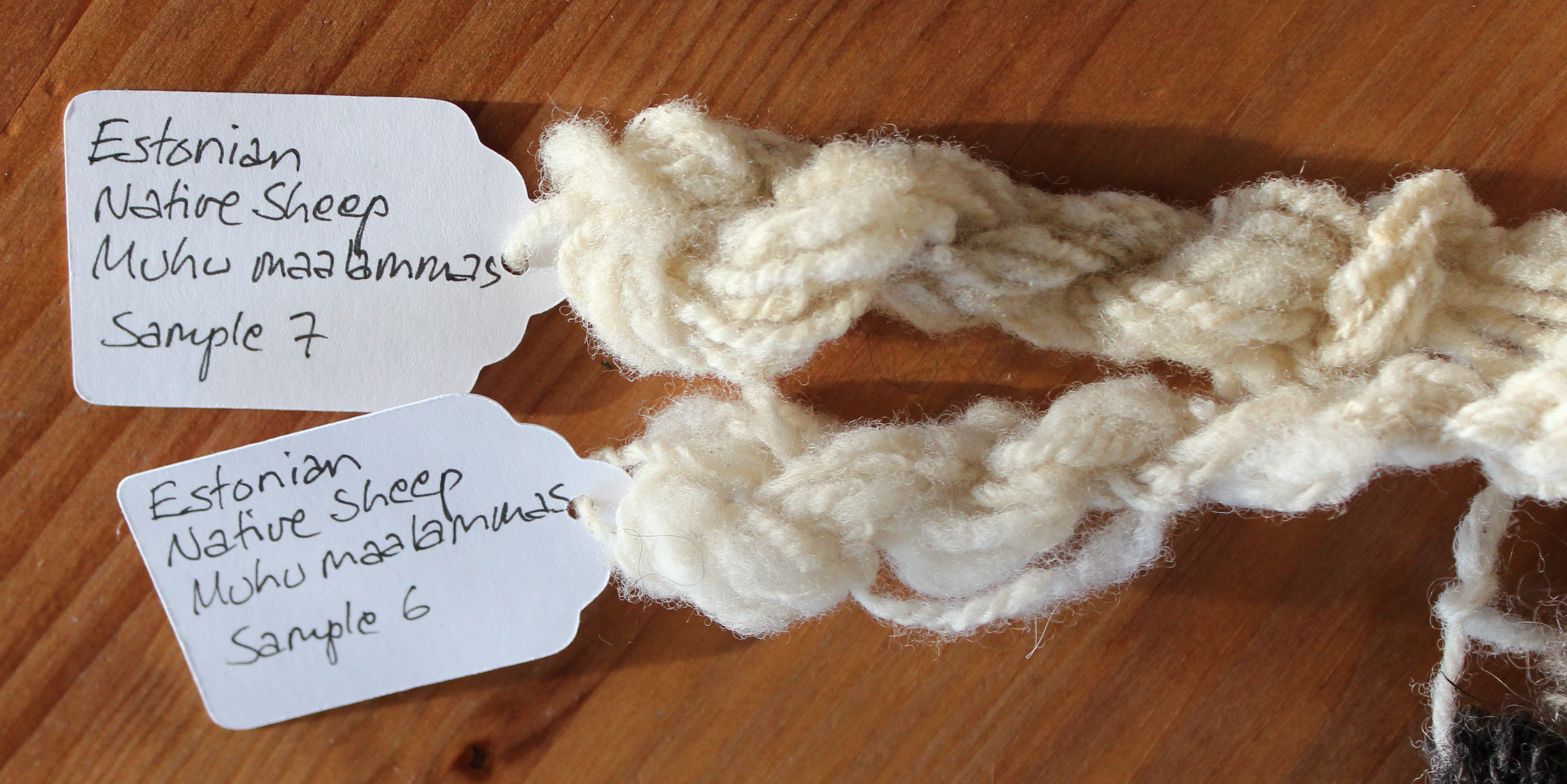
Samples 6 and 7 were too brittle to card, but they were an exception. Both are extremely fine wools, very close to what we think of when we talk about the finer qualities of Merino. There was a severe attack of horseflies in the flock that provided the samples, and especially the young ones suffered from it. The farmer and her partners used the wool for felting.
The flock is primarily used for landscape conservation grazing in the Muhu island off the western coast of Estonia.
The wool had been washed in the sea, which in this case means it’s been washed in slightly salty water. The water in the Baltic Sea is brackish with less than 34 promille salinity. I’ll return to the interesting matter of wool and sea water in another post.
Kadri later told me something interesting in an e-mail: “Actually about sea minerals – back in soviet times Saaremaa wool was known to be more soft than mainland wool because sheep grazed on seashore meadows with more minerals. I’m not sure these minerals work when applied outwardly, but when taken inside they are only a benefit for the wool :)”
Let’s move on to my sampling. I carded all samples except the two brittle ones, that I didn’t process any further than to see if the wool could be used. I spun a meter or so on a drop spindle. I spun all other samples on my Hansen Minispinner, and made 2-ply yarns. I did not wash the wool, as I wanted to work with it as it was because of the very special way it felt when touching it.
I use a gauge for measuring crimp that I’ve copied from Dansk Fåreservice (I sincerely hope I don’t bread any copyright rules by showing it). It measures the amount of curves per 3 cm.
Sample 1. Black wool with bleached tips. This wool had enough lanolin left to make it difficult to card and spin. I took off most of the tips. I tried to spin woolen, but had to modify into a semi-woolen/double draw. Staple length: 9 cm. Crimp: 5.
Sample 2. Black wool with bleached tips. This wool had almost no lanolin and was much easier to work with than sample 1. I left the bleached tips for a tweedy effect. The wool was long enough to be combed, but I wanted to prepare all the samples in the same way, so I carded it and spun woolen/longdraw/double draw. That worked well too. Staple length: 10 cm. crimp: 6.
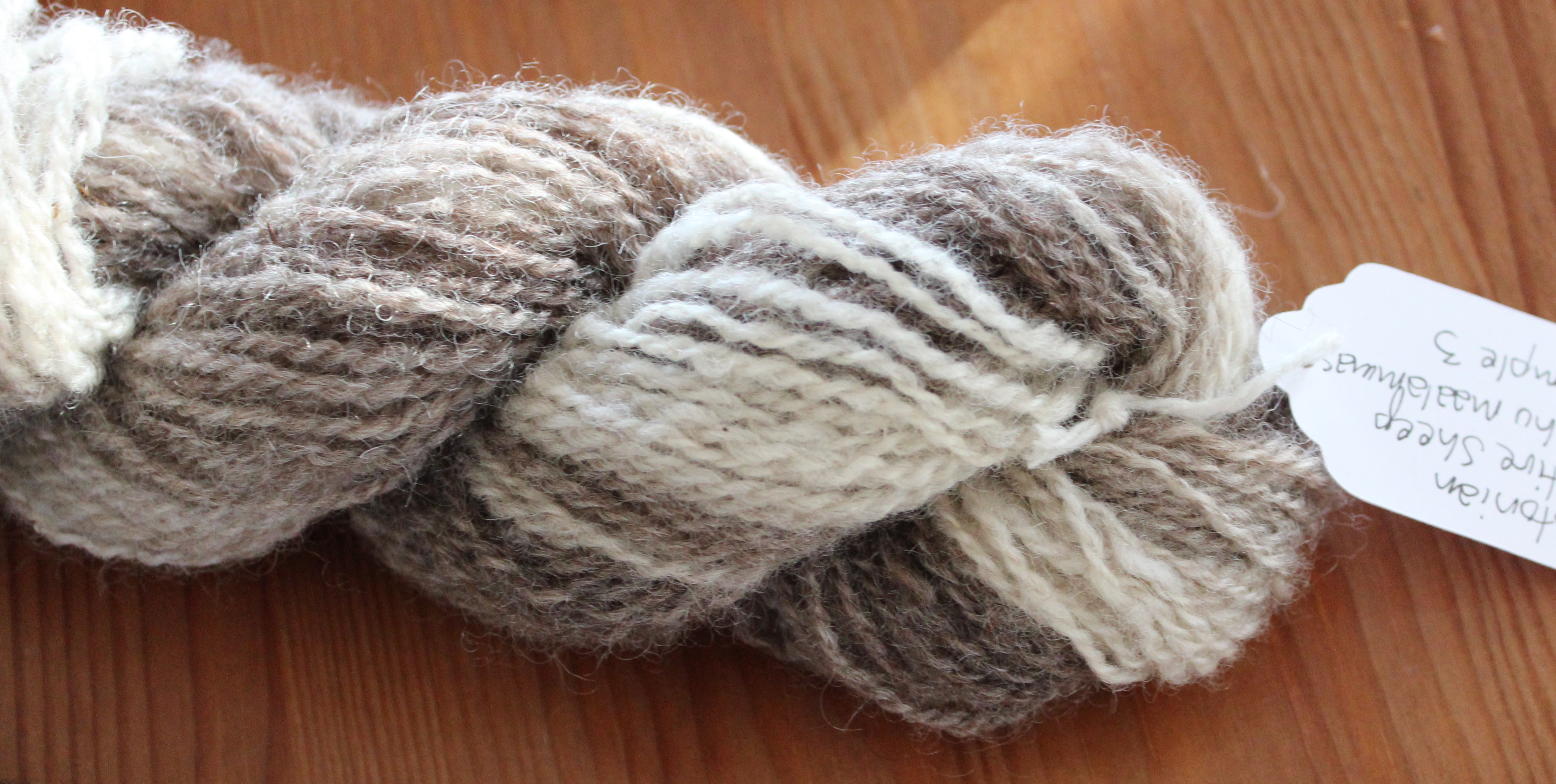
Sample 3. Tri colored fleece. Soft wool of good quality. I carded it without trying to blend the colors, or sepataring them, only picked them randomly from the fleece. I spun two bobbins woolen/double draw, starting with the lightest color and ending with the darkest. Staple length: 14 cm. Crimp: 4.
Eesti maalammas, tricolor
Sample 4. White, strong wool, that most of all resembled some of the longwools, like a sturdier Cotswold or finer Leicester. I carded it, but it could have been combed. I spun against twist. Staple length: 10 cm. Crimp: 3.
Sample 5. White wool with low crimp. Soft! It opened up well, but – there was scurf. I decided to leave it and see what eventually falls out, which proved to be almost all. There was three types of fleece: wool, hair and kemp. It’s lovely wool, suitable for sweaters, socks, hats, mittens and woven fabric. Staple length: 8 cm. Crimp: 4.
Sample 6. Very fine white wool. It’s fragile and can’t be carded without breaking, so I only spun a short thread on a drop spindle and doubled it. The wool is very soft and could be used next to skin, lace, and in baby clothing. Staple length: 9 cm. Crimp: 5.
Sample 7. Very fine white wool. I think this could be neck wool from the same sheep as sample 6. It broke when I carded it, so I chose not to work with it more than in four tiny rolags that I spun on a drop spindle. The wool could be used in the finest of lace yarns and in baby clothing. Staple length: 8 cm. Crimp: 6.
Sample 8. Very fine wool with a high percentage of lanolin. It’s soft and merino-like, and can be spun into super fine yarn. Next to skin, shawls, scarves, baby. Staple length: 5 cm. Crimp: 5.
Estonian Native Sheep. Samples 1-8
I was at once thrilled by how the wool felt. We call it “hand” or “handle”, the way wool feels when you touch it and work with it. It’s impossible to describe in words the information your hands give. I knew I hadn’t felt anything like this wool during my 30 years of spinning. All finished yarns are soft in way I haven’t experienced before. The yarns are also strong, so even the winter wool was of excellent quality.
I was naive enough to ask what people know about wool and sea water in two groups of spinners in Ravelry and Facebook, and also in Online Guild of Weavers, Spinners and Dyers’ discussion group on Yahoo, hoping to have a few answers. I now sit here with 30 printed A-4 pages of discussion! I will make a summary in another post. What an amazing community spinners are!
The textiles in Estonia are colorful and made with great skill. Muhu is known for it’s rich tradition in knitting, embroidery, band weaving and braiding, and there’s amazing crochet also. This photo shows a page from the book “Meite Muhu mustrid” by Anu Kabur, Anu Pink, and Mai Meriste. My Estonian guild friend Reet was kind enough to lend it to me. It’s a luxurious book like so many others that have been published in Estonia the last few years. It has wonderful photos, and the charts are so clear that even if you don’t know Estonian, but have basic skills in knitting, embroidery or braiding, you manage without the text if you want to make some of the socks, mittens, or clothes.
From “Meite Muhu mustrid” by Anu Kabur, Anu Pink, Mai Meriste
I decided to create a new blog. I want to move on from http://hillevisthreads.blogspot.fi/. I have seen from the stats that most of my readers come from other countries than my own, so I will write almost entirely in English.
I also think it’s time for me to use my own name. I’m still hillevi3 on Ravelry, but I use my real name, Barbro Heikinmatti, on Facebook and Pinterest, and on Twitter I’m BarbroHei. Not that I have time to post very often on Twitter, or even have something to say. I just like to follow others who work with textiles there, and to keep an eye on what’s happening.
The contents of my blog will be the same as in Hillevis Trådar: mostly about spinning, fibers, textile, sheep, and things I see and find interesting.
I hope my readers will join me here – I welcome you all!







 Barbro's Threads