Category: Spinning
Blooming spinning wheel and castle wheel
I was in my old home town Vaasa yesterday with hubby. While waiting for him when he did some errands, I went to the Ostrobothnian Museum to see if an old spinning wheel I’d heard of would be on display. It was, but I also saw this one:

Absolutely awesome! I couldn’t believe my eyes! I’ve never seen anything like it, except some new wheels that are also resplendently made and painted. The wheel is from the island Björkö in the Baltic Sea.
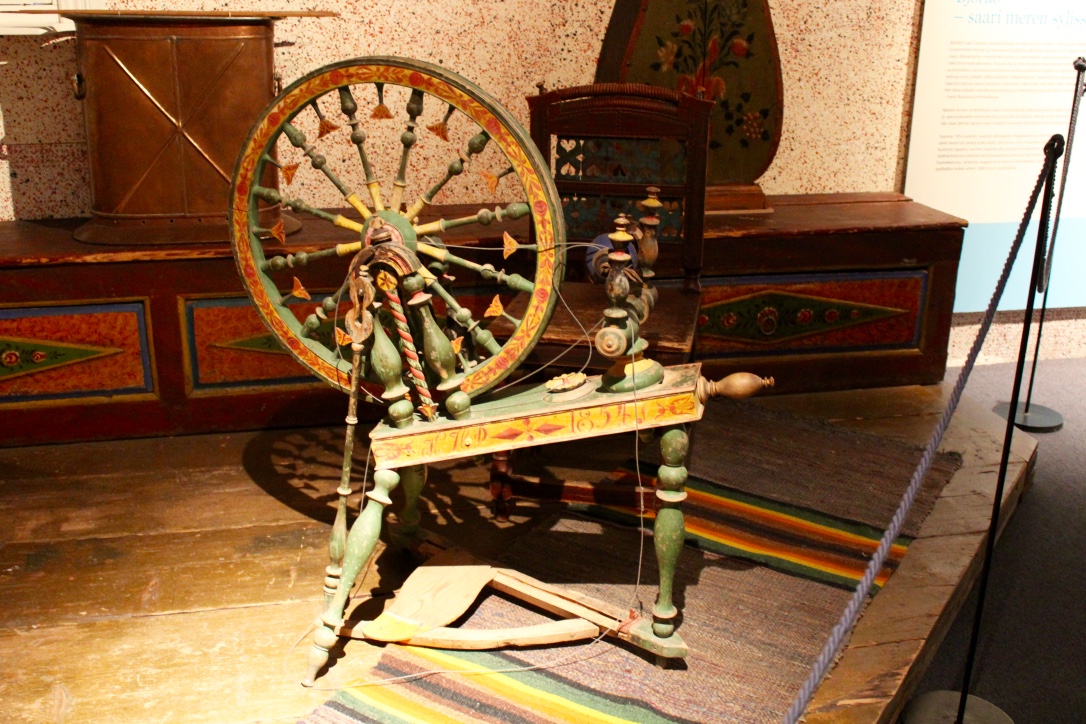
The light was bad for taking photos (but very good for just looking at the objects), but I still hope you can see the year that’s painted on it: 1854. It’s in very good condition, so must’ve been appreciated also after it’s no longer been used.
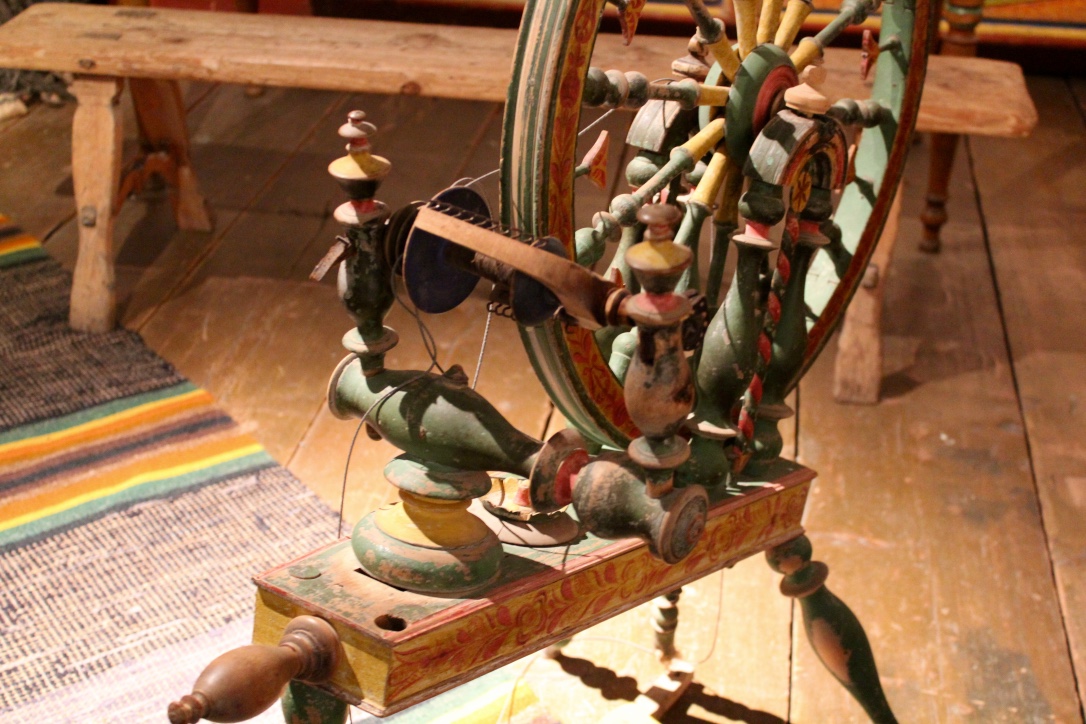
The bobbin is dark blue. Hard to say whether it’s original, but it did look as if it belongs to the wheel.
The furniture and the textiles are typical for the island: rich, bright colors, much red, green, blue and yellow.

And here sits the man in the house mending fishing nets amongst all this beauty! The bed is special: in Björkö shelves for plates were built onto the headboards. I didn’t see the reflexion of the glass cabinet facing the bed until I downloaded the photo, but I think you still can see the plates and bowls. The walls are sprinkled with red paint, very decorative and effective.
This is the wheel I went to look for. It also was behind glass, like so many of of the other objects in the museums nowadays, and therefore camera stands usually are forbidden. That makes me a bit grouchy, even if I can understand why I’m not allowed to mess around with sticks.
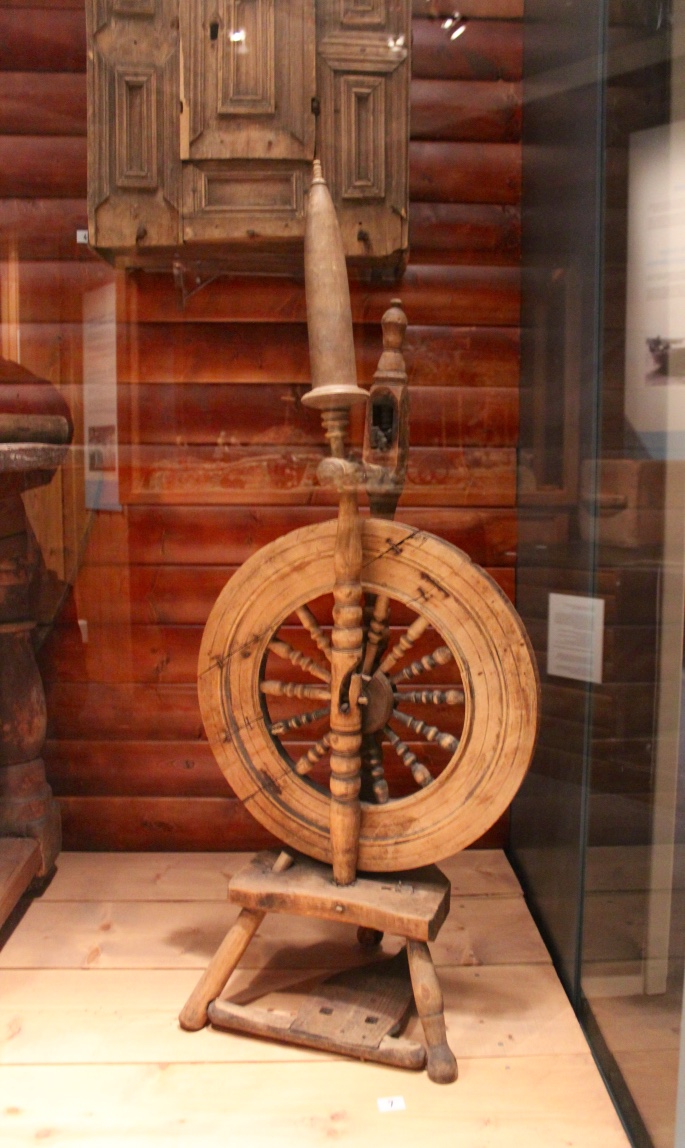
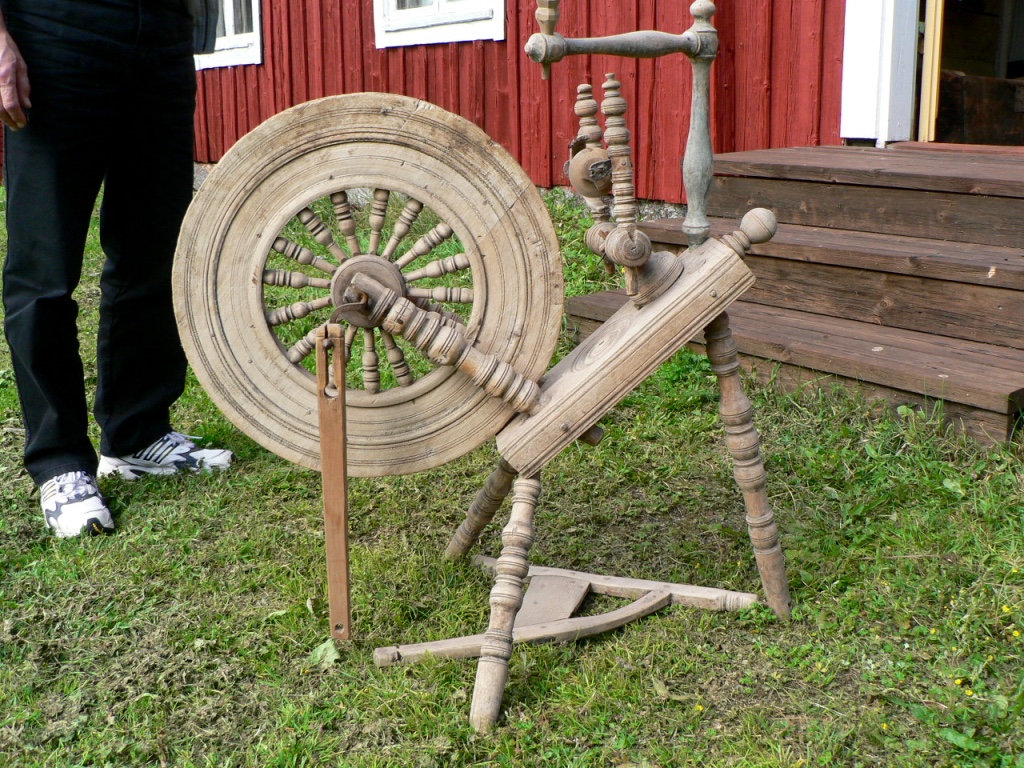
What you see is an upright wheel from the early 18th century, found in Karijoki in southern Ostrobothnia, now in the museum in Vaasa. The flyer and bobbin assembly is missing, which of course is a pity. This is one of the few old castle wheels there are in Finnish museums. I don’t know if the flax distaff is original, but it’s plausible the wheel once has been equipped with one of the same type.
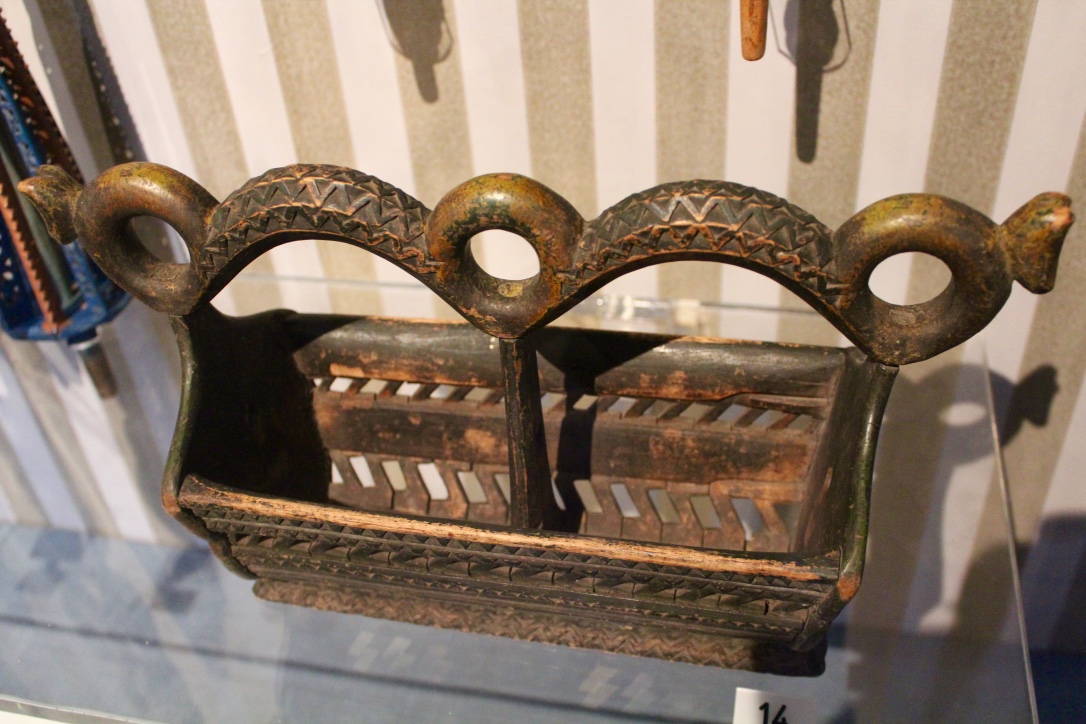
Next week: distaves, lazy kates, and other goodies! A teaser: this lazy kate is from Toholampi in northern Ostrobothnia.
Ultra fine Merino
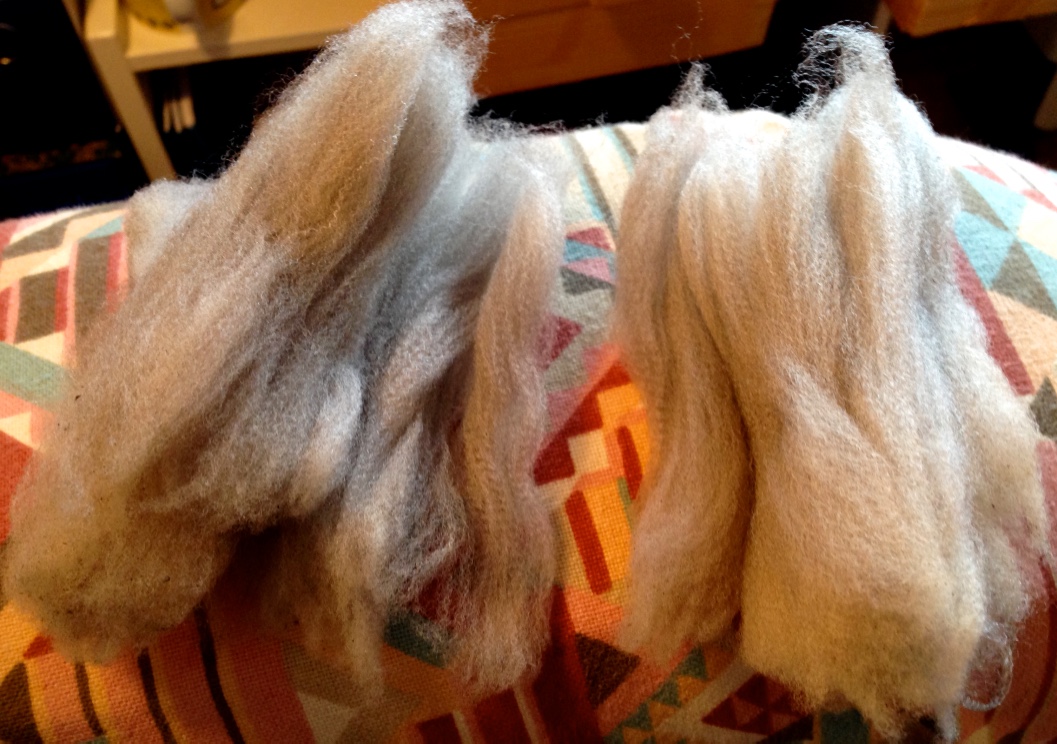
There’s a smallholder in Australia with 100 Merino ewes and a few rams. Nui Milton is also a fabulous spinner. You can follow her on Facebook, look for Casalana Wool. I bought 200 grams of grey locks from her, scoured a few staples at a time, flicked them open in both ends with a small dog brush, and spun from the cut end as fine as I had the nerve to. I wanted a shawl yarn that can take some blocking, so I didn’t spin as fine as I could’ve done. No, I’m not boasting! This wool can be spun so fine you can’t see it! You only have to be patient, take breaks, don’t spin when you’re tired. I know some of the participants in The Longest Thread competition in Bothwell use Nui’s wool.
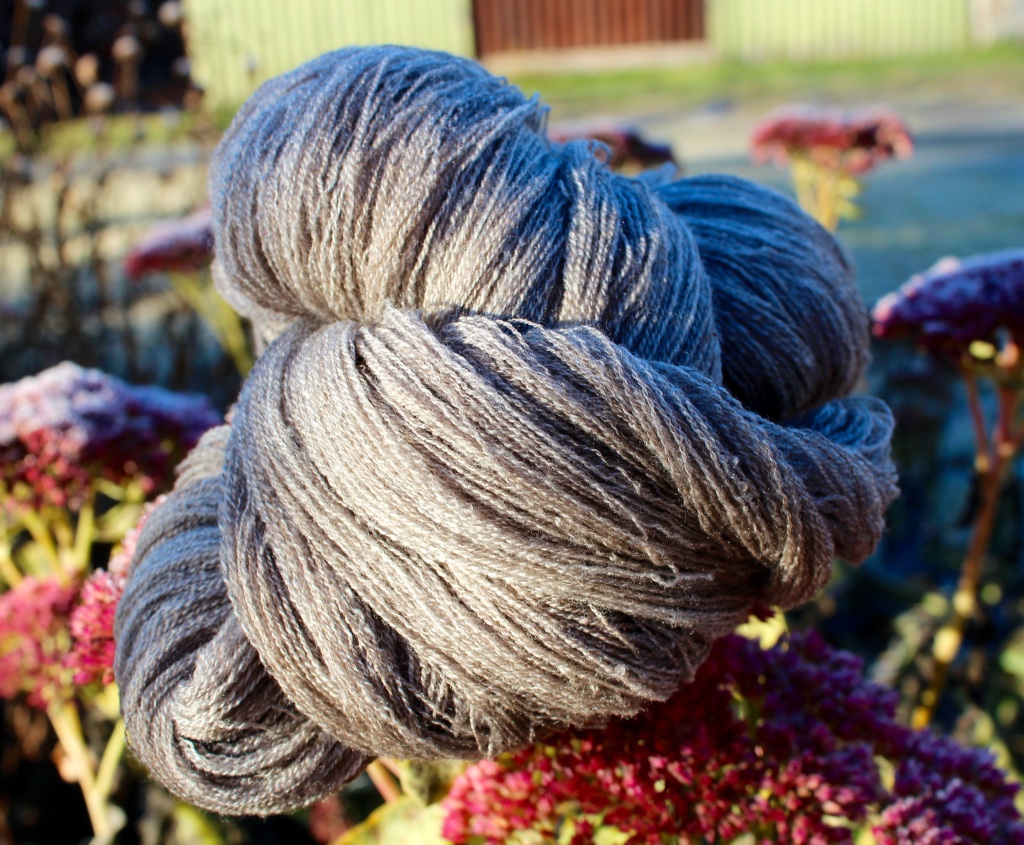
70 grams, 1260 meters. Enough for a small shawl.
Nui has found a way to keep the staples in order when stored. She simply uses rubber bands! They are easy to remove, and they don’t damage the delicate fibers if your careful.


I’m sorry for the bad photo quality. I hope you can still see how lovely this Merino is. I like Merino, I like the way it feels, how it just lines up into fine, soft yarns. It’s not a fiber for beginners, but once you’ve learned the basics of spinning, and feel comfortable with you wheel or spindle and your drafting, you can spin it.
I spun on the Hansen Minispinner (lace flyer), and plied with the WooLeeWinder.

Next step: to knit a lace shawl!
Toika spinning wheels
In my previous post I mentioned a wheel made by Toika Looms some decades ago. They haven’t produced spinning wheels for a long time now, and it seems to be difficult to find information about them. But I got some info from Toika Looms, which is shown below:
 I don’t have any more info than in the text. It’s interesting to see they also made an upright wheel. A Finnish upright wheel was mentioned in a discussion in a group I follow on internet (as so often, I don’t remember where). I haven’t seen the Irene wheel so far. I may have seen the Ulla wheel without knowing what it was.


If I had time to do research on our wheels, I would probably find some information. But as I don’t have that time, I only hope that someone would take on this task. There are university students out there who could do it as part of their studies. But what I can do is to go to museums wherever hubby and I end up on our road trips, and I can take photos if that’s permitted. Not all museums are that kind to people like me, who point there cameras at everything in sight. It’s a good plan for next summer! When I told hubby about a wheel with golden decorations in a museum in northern Finland, he said “I thought you’d like to go there, I saw the road sign a while ago”. He was on his way to another town a few hundred kilometers east, and when seeing the word “Museo” the dear man thinks of me. I wonder why? I leave it to you readers to decide.
Thanks to the kind spinners in the Facebook group Kehrääjät, who have given me some hints on where to find nicely decorated wheels! Silver and gold, that’s something to ponder upon during the cold dark winter that is soon upon us here on the northern hemisphere. Thanks also to Toika Looms that kindly sent me the info above.
EDIT: Right now I got a message from Betty in the Netherlands, telling me there is a group for these wheels on Ravelry!
EDIT 2: More information from Toika today in an e-mail to me: Toika stopped making spinning wheels in the 1980s. Most of their wheels were exported, and the upright Irene was made for export only. This explains why I haven’t seen any of the Toika wheels yet here in Finland.
Wheels for my readers
I looked through my photos and chose a few spinning wheels for my readers. When I look at my stats, I see that a majority of you are in the US, followed by Finland, and the rest of the world. (That’s why I write in English, and not in my mother tongue Swedish.)
Here’s a bouquet of Finnish spinning wheels for my international readers. They are all from museums, mostly from Ostrobothnia, the middle western coast of Finland where I live. The Saxony wheel was designed to spin short, carded wool in an efficient way using the long draws. It’s not an easy wheel for a beginner, but this is what the young girls still learned to spin on. I love the smooth, wide movements in the long draw as we spin it in Finland: as long as your right arm reaches, drafted to the right without twisting your body backwards as some of the other long draws demand.
First: the proper way to attach spokes. If you look closely, you see that they don’t go in a straight line, but more in a zig zag line. A Norwegian friend told me that this prevents the wood from breaking. There are usually six slightly bent parts in the wheel, forming a perfect circle. You can see a faint line in the wheel where one of the joins is. This wheel is in a museum in Vaasa.
A typical wool flyer has fewer hooks than a flax flyer, and it’s wider. The Saxony wheels in Scandinavia were used for both flax and wool. You can spin both on either of the flyers, but thicker wool yarns tend to catch on the hooks of a flax flyer. Below a wool flyer. There’s also a skein winder with a counting train. Professional spinners always measured their yarns, as there had to be a certain length in each skein. This wheel is in use, and the spinner has secured the drive band because of all the kids that want to spin the wheel and make a mess of the band.

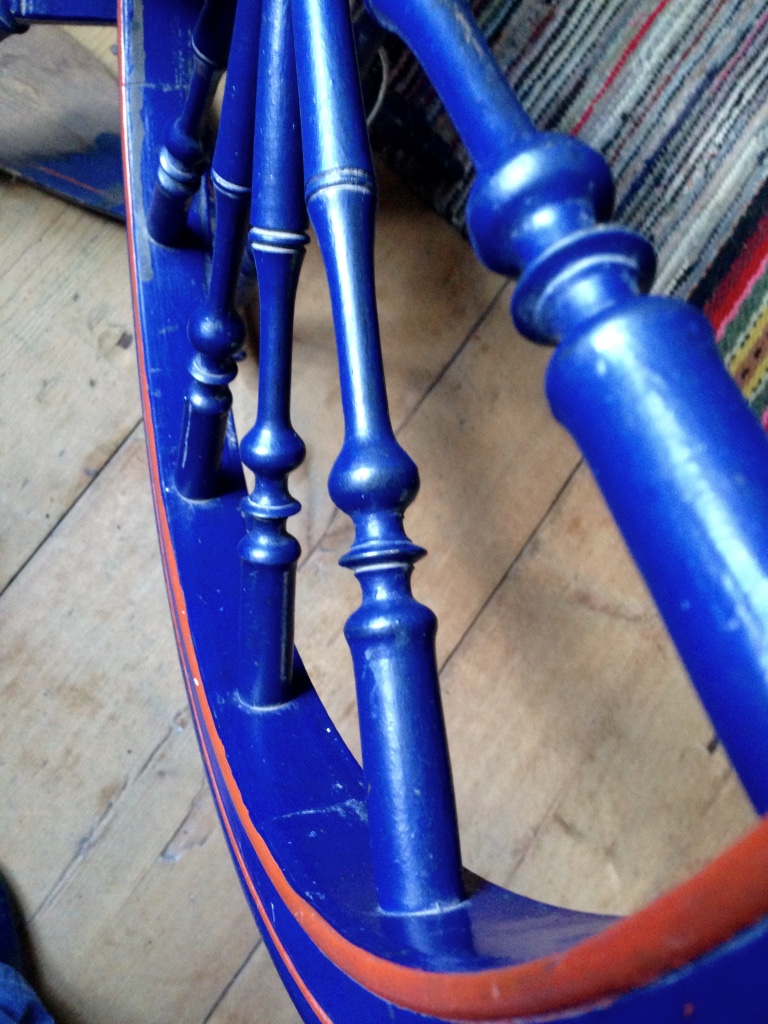
Deep or lighter blue wheels with red details were common in my part of Finland.

This wheel is in a museum in Taivalkoski in north eastern Finland. I don’t know if the colour was common in the Kainuu region, or if the wheel has been brought there from another part of Finland.

A green wheel from Malax in Ostrobothnia. Green wheels can also be found quite often here.

An old wheel from Korsnäs, the home of the famous Korsnäs sweater. There’s no dating, but in my eyes this looks older than the Saxonys from the late 19th-early 20th century that we have seen above.

This is an old wheel. On the other side of the drive wheel there’s a carving “1739”. It seems to have been added later, but it must have some significance. Either it is the year the wheel was made, or the year the spinner got it. I love it, I think it’s very beautiful. The distaff is much newer, and the footman seems to be of later age also. The wheel is in a museum in my municipality. No, I haven’t been permitted to try it – I’ve asked 🙂 But it works, I’ve tested it that much.
This wheel is in a museum in the Finnish speaking part of Ostrobotnia, Vähäkyrö. It’s dated 1611, but that seems to be wrong. No authorities have yet accepted the date, and the reason is that flyer wheels were almost unknown in Finland at that time. Until we know for certain, we just have to admire it. It seems to be a relative of the one from 1739 above. Strong wheel, very steep bench.
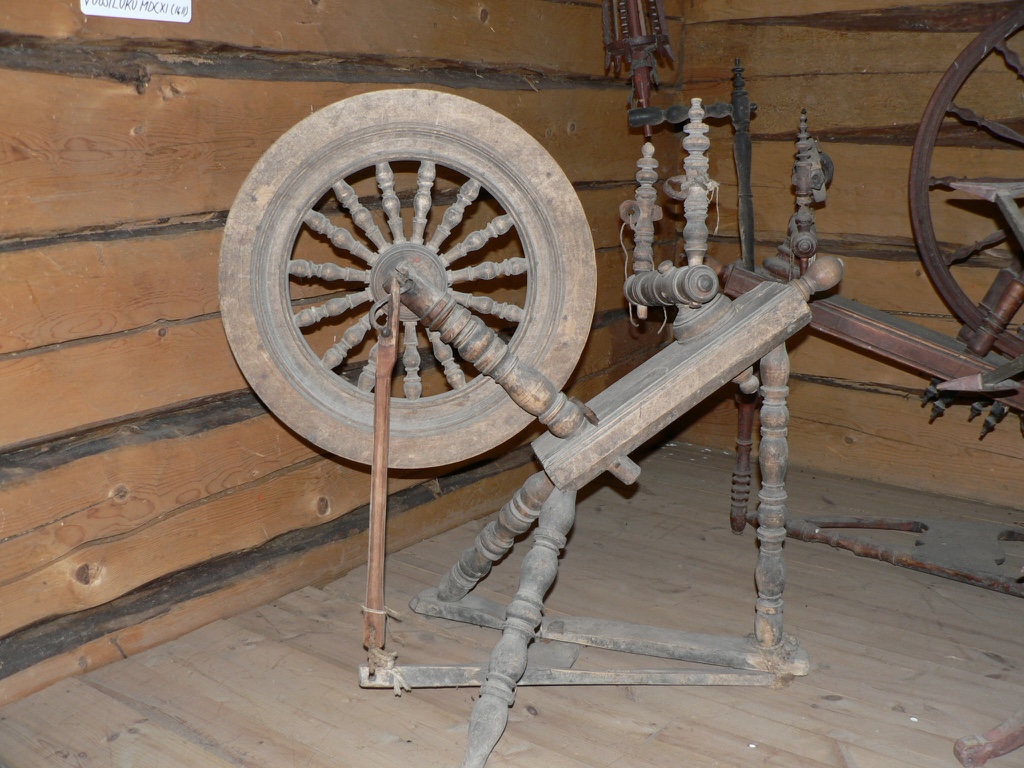

The museums have so many spinning wheels, that they can’t display them all. The one above is stuffed away in a barn at a museum in my municipality. I wanted to show it because I believe this kind of wheel must’ve been common. It’s a simple undecorated wheel that has clearly been in use. How many of these have been used as fire wood, as there’s no elaborate wood turning or painted decorations? It’s just simply a tool.
Now here’s a classic: a spinning wheel from Kiikka, a municipality in south western Finland that was so famous for it’s wheel production, that there’s still a spinning wheel in its coat of arms. It’s called “Kiikkalainen” in Finnish, and easy to recognise because of the way it’s decorated. I have one of these, and it’s indeed a very good Saxony. This is from a museum in northern Ostrobothnia, Kokkola.

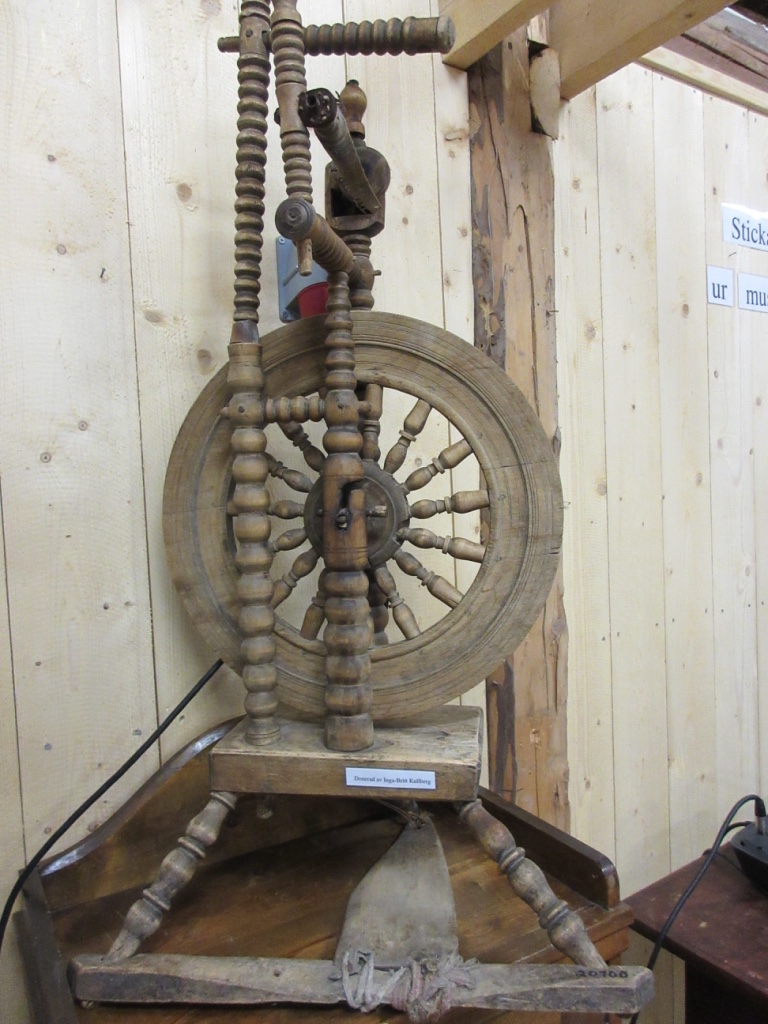
Upright wheels are very sparse in Finnish museums. There have been upright wheels earlier, but they have disappeared probably before museums became common. This wheel is in a museum in Malax, where you can also find the green Saxony above. It’s history and origin is unknown. A discussion in the Antique Spinning Wheels group on Ravelry couldn’t establish a precise region, but Germany, Netherlands, or Belgium seem to be closest guesses, much because of the wood turning style.
Almost every municipality in Finland had at least one wheel maker, often several. The spinning wheels were of great importance, as industrially made textiles didn’t become common until the end of the 19th century, and in many rural areas even later. All small holders and bigger farms had sheep, and flax was grown until the second world war. All women could spin, some better, some just acceptable for work clothes and blankets.
So what happened? The simple question is: man made fibers. During our last wars against the Soviet Union (1939-1944) all capable men were at war. The women and children took care of everything else. I’ve heard so many of them say that after the war they put away their wheels, because they reminded them of the never ending exhausting work, when spinning was the last task late in the night when everything else had been done. The man made fibers and mill spun wool yarns saved the women from the spinning wheels and looms.
So here you find many of them now: this is from an attic in one of the museums close to where I live:

Sleeping beauties beside their skein winders.
Many wheels also ended up in the grandmas’ attics. Now they are often sold on the second hand market, and luckily there’s a steadily increasing number of spinners who want to use these old treasures.
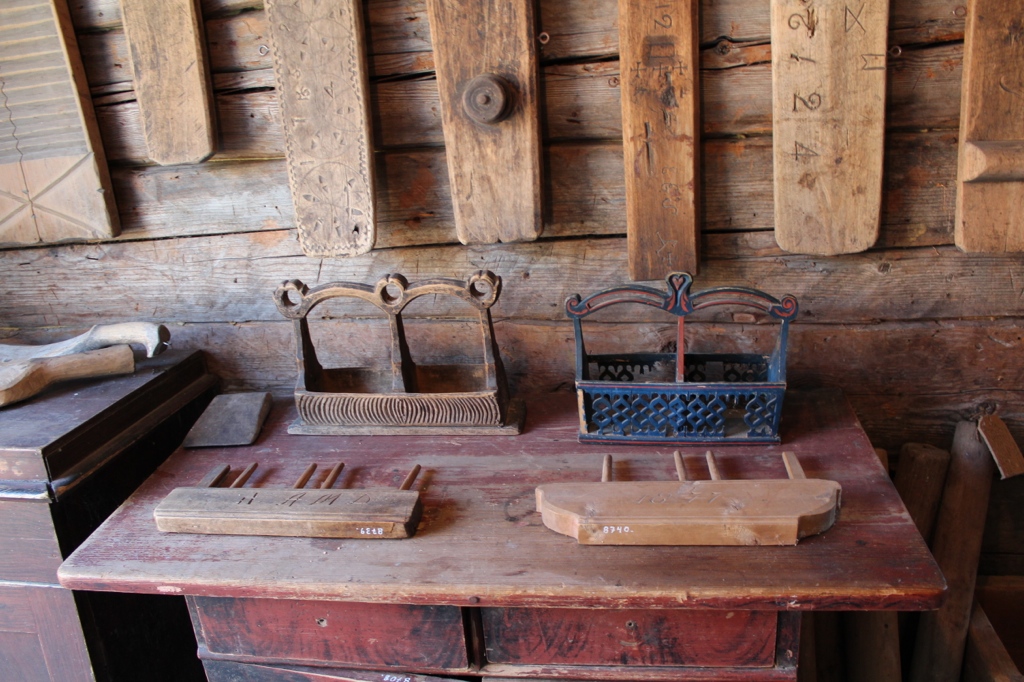
Here’s what happened next, when the spinning was done: plying yarn, making heddles for the loom. And after a while, doing the laundry and pressing the linen. This is also from my favourite museum here in my municipality.
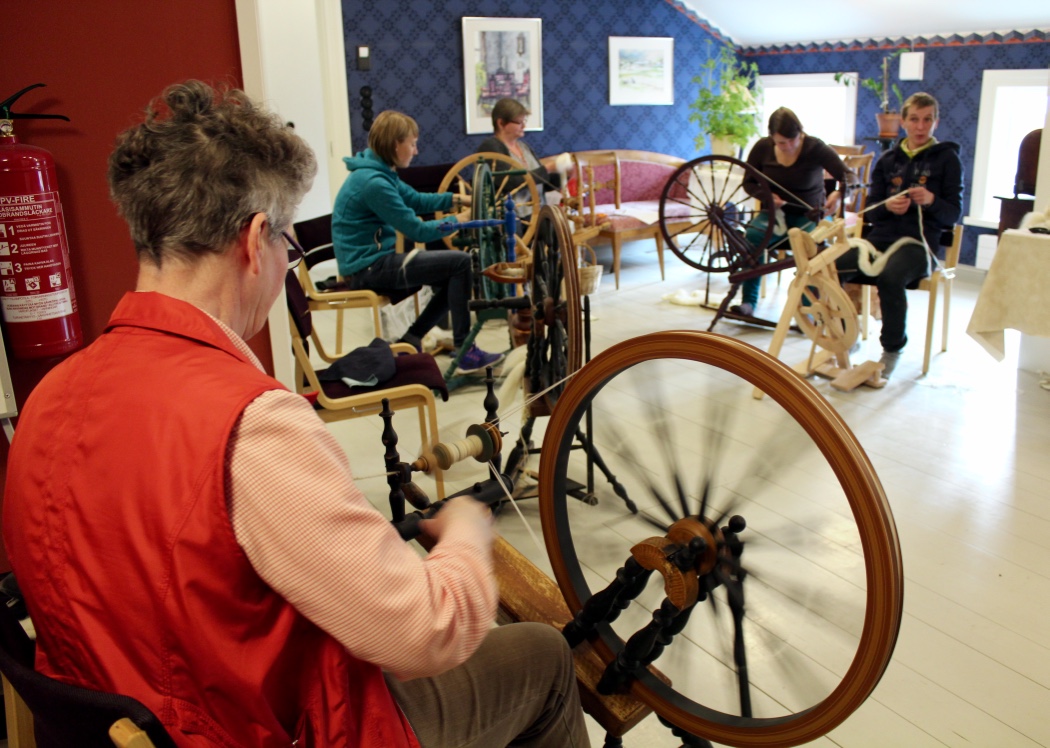
Spinning class
Last weekend I taught a beginners’ class in wheel spinning. Some of my pupils also took part in a spindle class last spring, and I was happy to see they wanted to learn more.
Five old Finnish Saxony wheels!

Two more Finnish Saxonys, and my Louet “Peerie” Victoria that I lent to one of the participants as the green wheel wasn’t in mood for working. The owner fixed it in the evening, but got so fond of my Peerie (who wouldn’t!) that she wanted to go on using it during the second day.
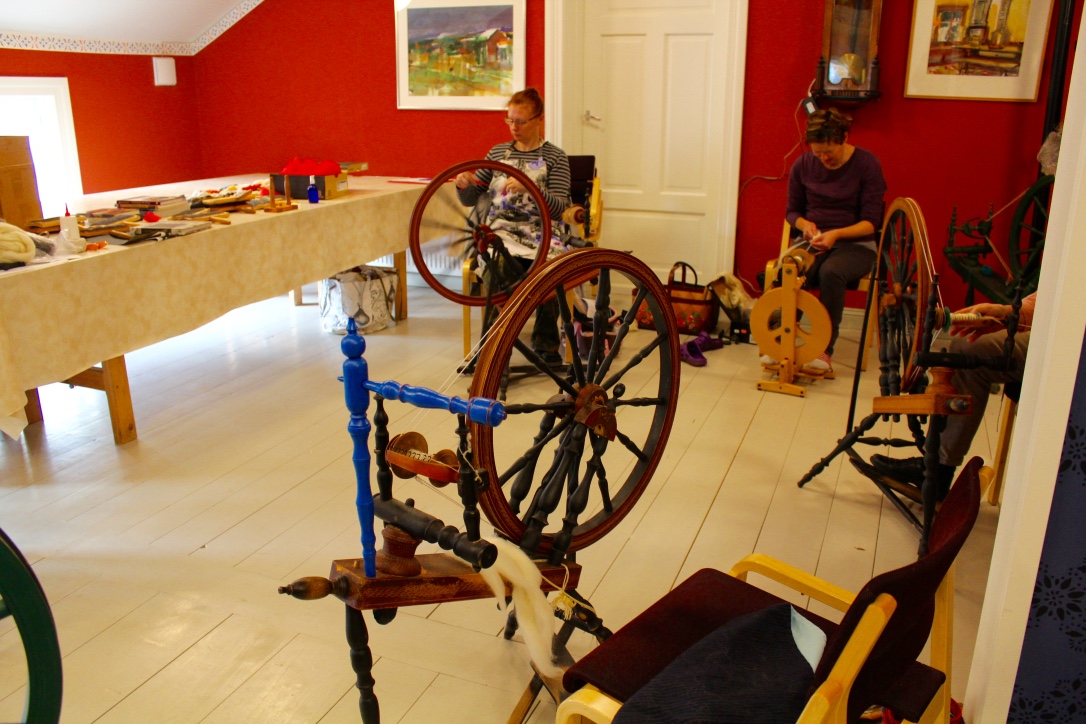
Finnish spinners will know what this is about: three wheels from Kiikka, called “kiikkalainen” in Finnish. The municipality Kiikka was famous for its skilled wheel makers, but all that ended when people stopped spinning. Luckily there are lots of old wheels in the second hand market, and among them hundreds of kiikka-wheels. You see mine (I call her Eevi) with the blue distaff stand in front. I use it for spinning in public, while my other two antique Saxonys are for home use only.

There was also a new German wheel, but I forgot to ask about the maker. Germany was, and is, an important country for spinners. All the wheels you see in this photo have their origin in Germany. The Saxonys came to Scandinavia from Germany centuries ago, and the upright wheels have continued to develop into interesting new forms there. I think the wheel in the front may be a Toika wheel, but if someone knows what it is, please tell me! It’s unfinished. EDIT: A kind reader has sent me a photo of a Toika wheel from the 80s. It’s much more robust than the wheel in the class, and many details are different. I therefore think the one in the class isn’t made by Toika.
My pupils had various skills from none to quite advanced. It’s always difficult to teach a beginners class to people who needs very different kinds of knowledge and skills. I had prepared myself for a situation like that, but you’d still need to be able to split into at least three persons! One who makes the wheels work, one who teaches the basics in spinning, and one who teaches advanced techniques.
But it was fun, thanks to the nice participants! The beautiful room in the Crafters House at Stundars is an inspiring place for small groups. I hope we can continue in the spring with fiber knowledge, fiber preparation, and one or two new spinning techniques.
Spinning with friends in Sweden

In August I was in Sweden and met old and new spinning friends. The photo above is from Luleå, where spinners meet quite often to spin together. As you can see, E-spinners are popular! Nancy is showing her blending board, and Yvonne is spindling.

Fibers! Britt-Marie is a skilled dyer.

More fibers. The group members buy, sell, and swap fibers. I came home with lovely red and green BFL/silk tops, and a beautiful grey Cashmere/silk top that I long to spin. I also have several bags of fleece.
After a couple of lazy and fun days in Luleå with Britt-Marie, we went still further north to Överkalix, where a couple of new spinners met up. We stayed at a self catering cottage, and spun in the evening before the final day of Överkalix Craft Week, when we spun in public in an old house that is now a museum.

The main building is an impressive building, especially when you know how harsh the conditions have been here in the north. It’s filled with beautiful furniture and artefacts, and also has a fine textile collection.
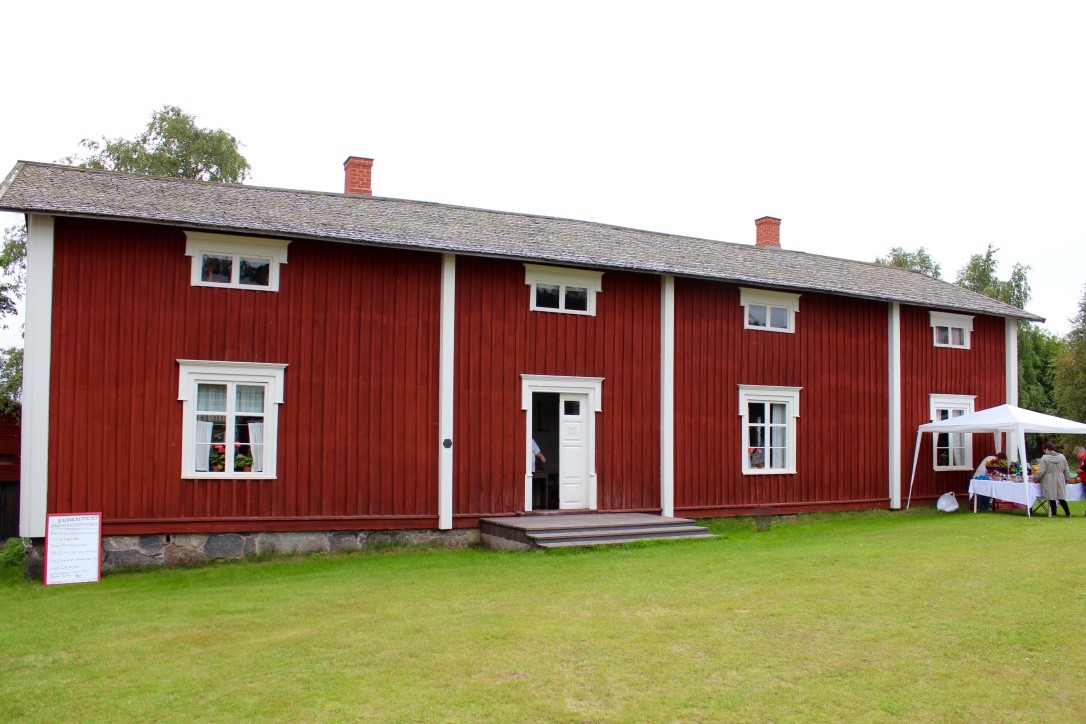
There are two rows of rooms in the house. Two spinning wheels, painted blue as they often are in northern Sweden:


A distaff for flax tow:

More distaffs:

The furniture is gorgeously decorated.

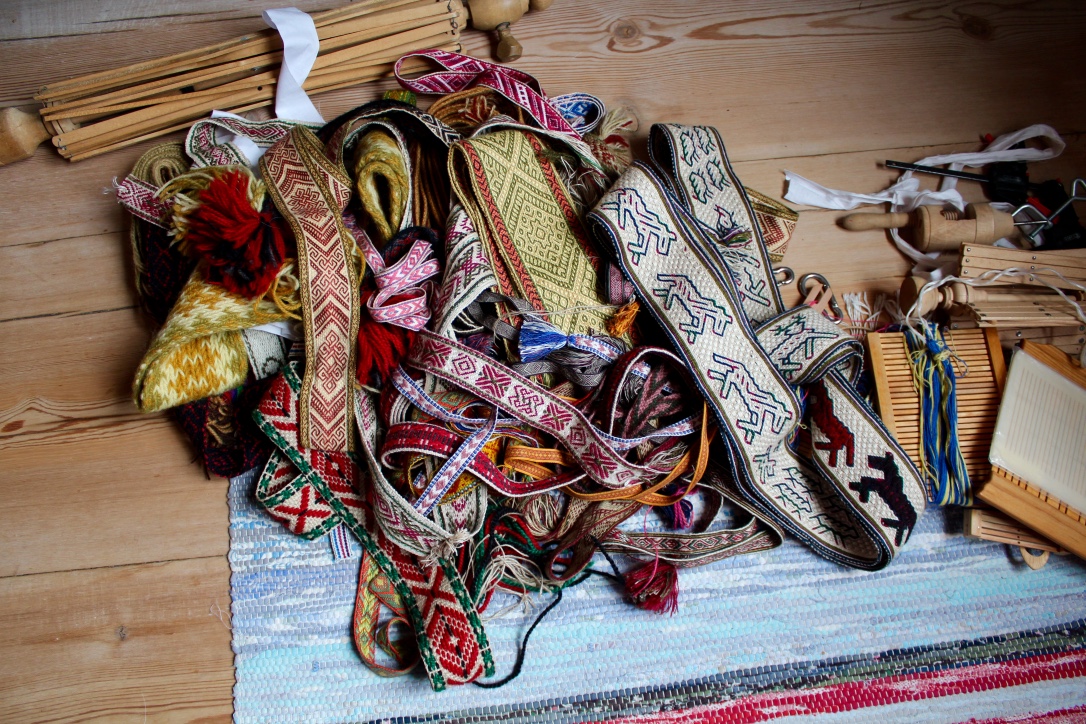
Louise Ström, one of Sweden’s best band weavers, taught a weaving class in the old house. These are some of her tablet woven bands:
A man showed ropes and cords made from different animal fibers: camel, yak, horse etc.

I forgot to take photos of us spinning in public in that fascinating house… so I can’t show any. But here’s a display of Swedish wools shown by one of the sellers at the market place:
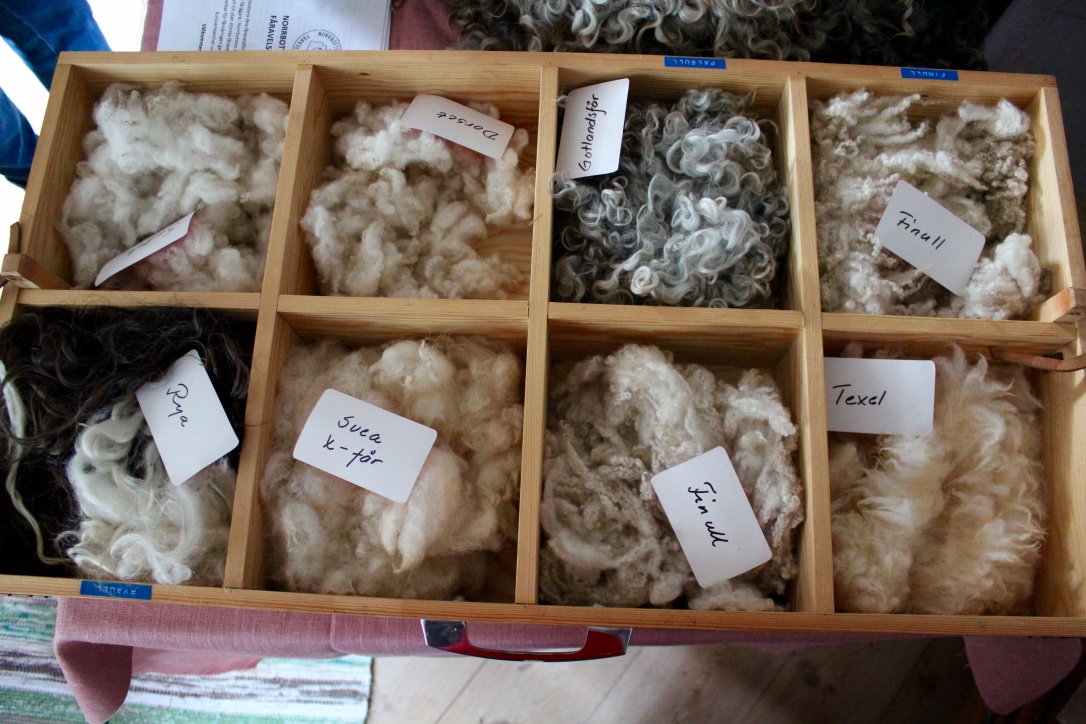
Sweden has a lot of interesting old sheep breeds, with wools from harsh to super fine and soft. I have only spun Swedish Finull and Gotland so far.
Kasper stayed at home with hubby, but I wasn’t totally dog-less. Britt-Marie’s two lovely dogs kept me company once in a while:

I was invited by my friends to Luleå and Överkalix, and I enjoyed it so much! Thank you all, and special thanks to Britt-Marie who kindly invited me to stay in her home!
Spinnkurs! – Kehruukurssi!
Nybörjarkurs i spinning på Stundars med mig som lärare 10-11.10!
Opetan Kehruun aloituskurssin Stundarsissa 10-11.10!
Välkommen! Tervetuloa!

Campanica
This was a nice new wool: Campanica from Portugal. The two wool samples I got were from the same sheep, and quite different in character. That is not unusual, in fact it’s what most sheep produce: different wools from different parts of the body. The site I linked to doesn’t mention other colours than white, but there are black/brown Campanicas also.
I prepared and spun a few samples, and then spun two different yarns:

The smaller skein: coarser wool with kemp. Carded and spun woollen.
The bigger skein: softer wool with a small amount of kemp. Hand combed and spun worsted.
This was interesting wool to work with. It reminded me a bit of some crossbred wools I’ve spun, like Finn/Texel. Soft with a bounce, and not so little of the bounce either! There was yellow stain in the softer wool, which can be seen in the slightly yellow tone in the yarn. It would be a perfect wool for many kinds of sweaters, from rough outdoor to in-between sweaters for winter use, and thinner for summer. Socks, hats, mittens. In Portugal it’s used for blankets and rugs, mixed with other wools. The coarser yarn I would use just like that, in a blanket, bag, or carpet.
I just learned that there is a number of people trying to preserve the traditional Portuguese ways to prepare and spin wool. They have a group on fb called Cooperativa Oficina de Tecelagem de Mértola. Use the fb translator to see what they’re doing.
Kainuu Grey and Merino for shawl
I spun three yarns for a shawl or scarf. It’s about 250 grams, but I forgot to measure the length. There will be enough of it, I’m sure. Something Shetlandish, yes?
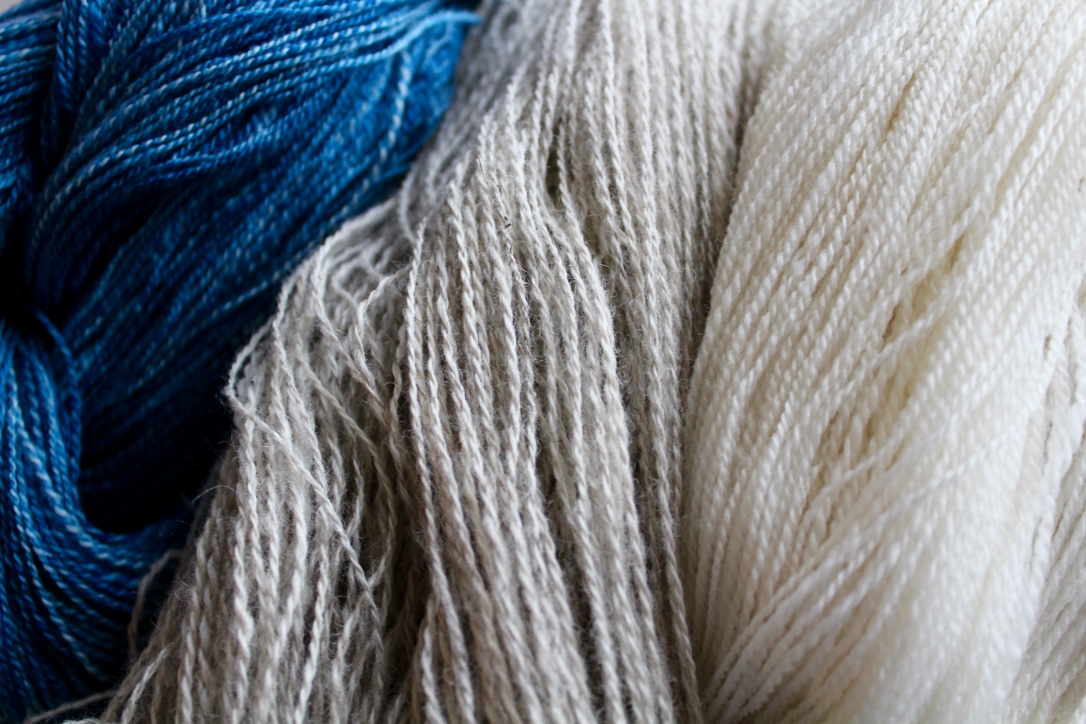
I used my new lace flyer and the Hansen Minispinner. I’m very fond of the lace flyer. It allows great precision in the drafting.
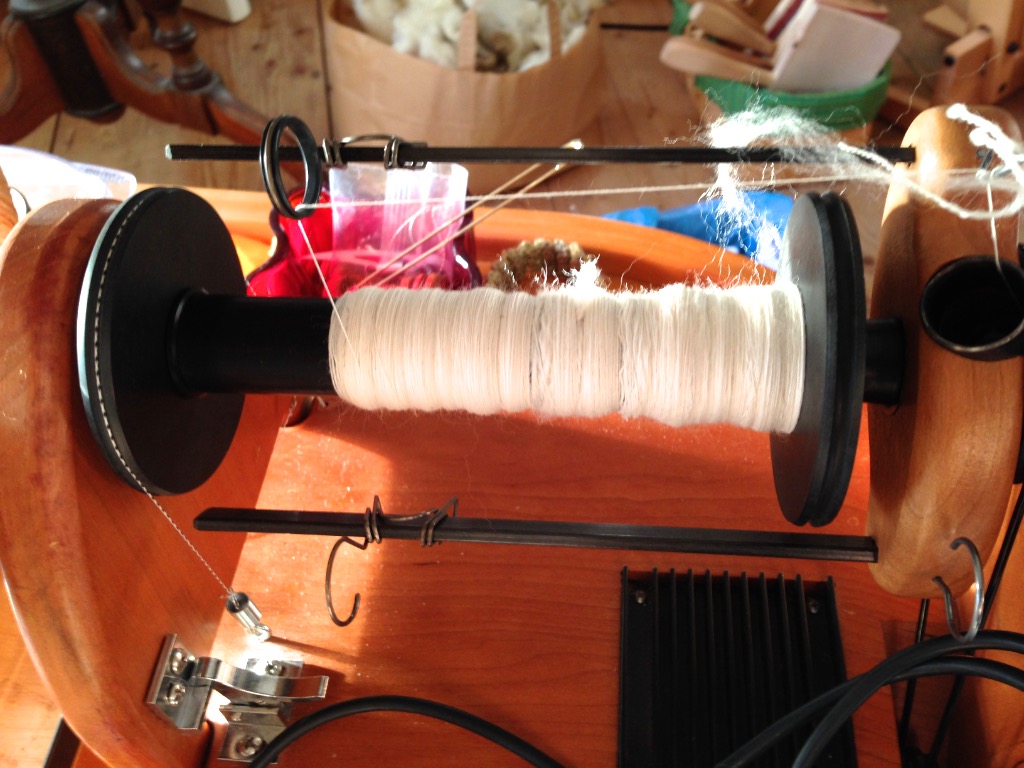
Dyeing and teaching
I dyed a fleece:

I bought several Finn x Texel fleeces to use in spinning classes. The wool is coarser than pure Finn, and easier to prepare and spin. This one I’ll spin myself. The bright colours I’ll use in a sweater for my granddaughter, the pale red and green in socks.
The spindling class last weekend was great fun! Seven ladies and a young lad got a first glimpse of the wonderful world of spindles. I love the new crafters house at Stundars. It’s built and decorated with the great skills you can expect from dedicated crafters. As always when teaching, I forget to take pics in class. I took this one, though:
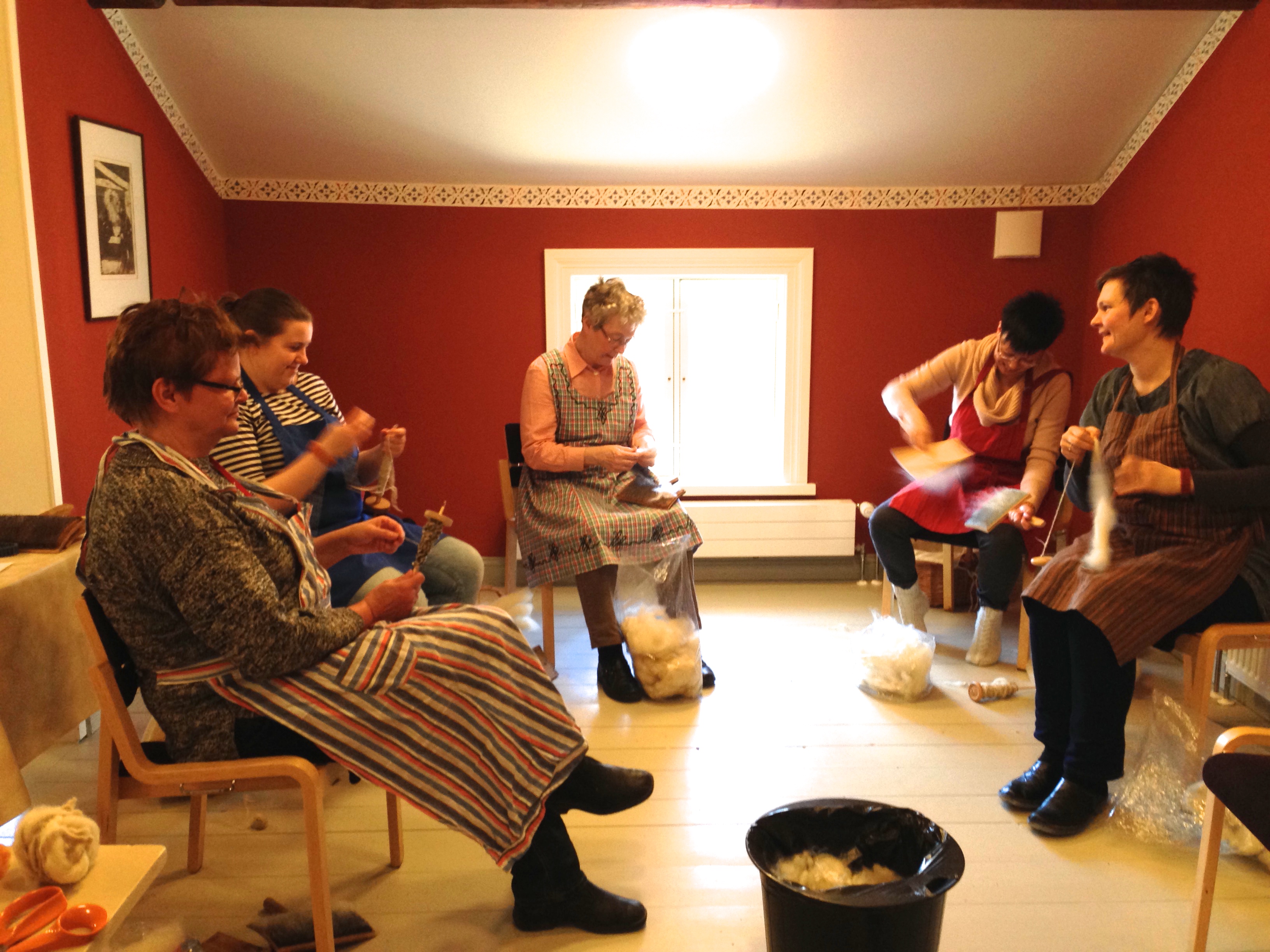

I showed my spinning wheels also, as an introduction to an upcoming wheel spinning class in the autumn.
 Barbro's Threads